Healthy Body: What It Means and How to Build One on a Busy Schedule
The short answer
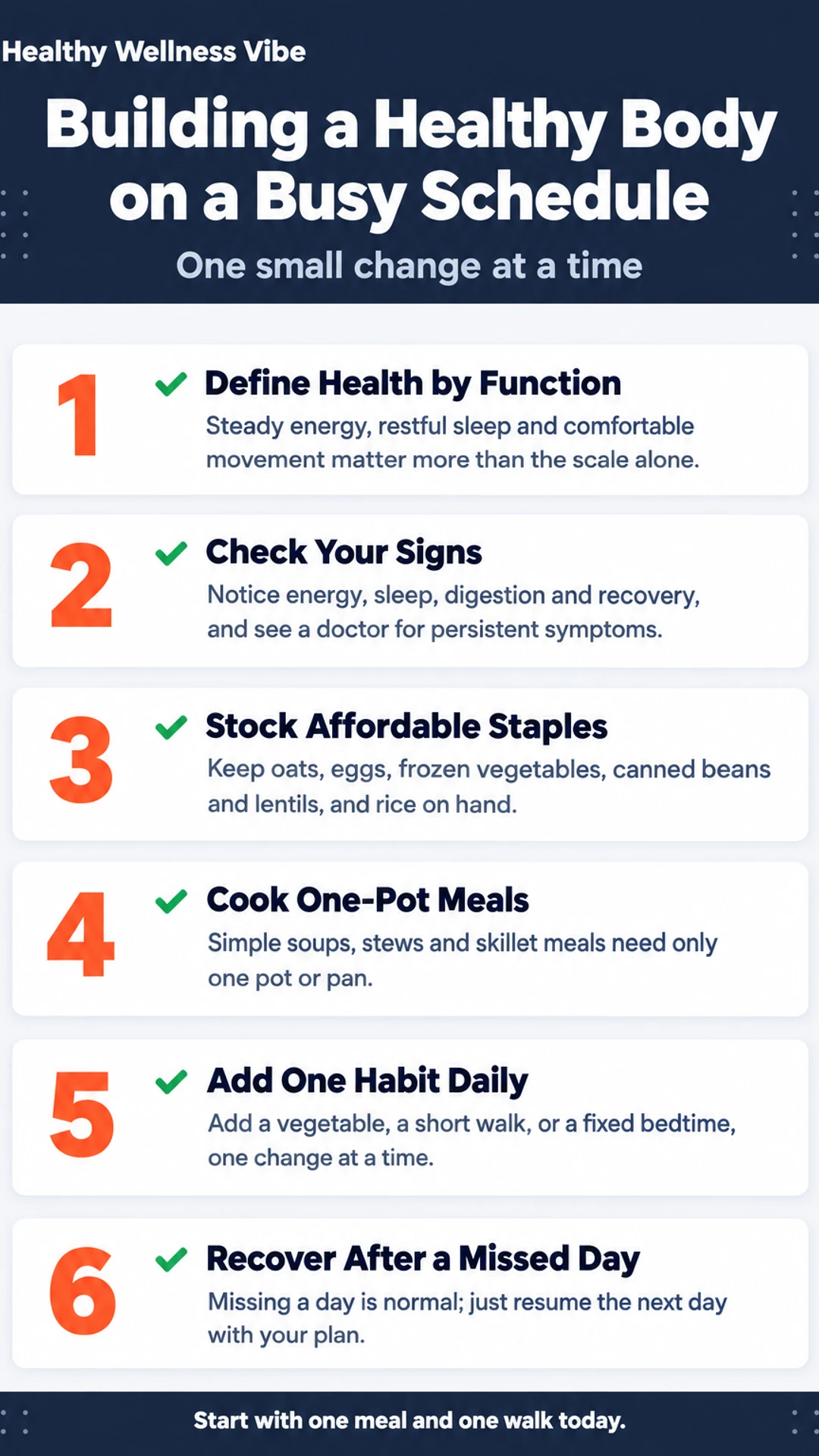
A healthy body is one that works well day to day: you have steady energy, sleep reasonably well, move without unusual pain, recover from minor illness, and keep your blood pressure, blood sugar and other markers in a normal range. Health also includes mental and social well-being. Good health comes mostly from ordinary habits: regular meals built around vegetables, fruit, whole grains, beans and protein, daily movement, and consistent sleep.
What this guide covers:
- What "healthy" means in everyday terms, so you can judge your own body without relying on a single number
- Simple meals and a 7-day starting plan you can cook with a few pans and a modest grocery budget
- Realistic routines for movement and sleep that fit around classes, shifts and a full workload
- A short list of affordable foods to keep on hand so healthy eating does not depend on willpower
- How to tell which advice applies to you, given your age, body and situation
If you have been trying to eat better and keep stalling, you are not alone. Most people do not fail because they lack information. They fail because the plan was too strict, too expensive, or too complicated for a week that already feels full. That is a solvable problem.
This guide is based on published guidance and what people commonly report, not on our own testing. The goal is a body that feels better this month, built from habits small enough to keep. Start with the next section, pick one meal and one walk, and build from there.
Walking Habit Progress Plan
Guides on this site
What a Healthy Body Means in Everyday Terms
A healthy body is one that works well for the life you actually live. The World Health Organization describes health as a state of complete physical, mental and social well-being, not merely the absence of disease. That definition is broader than most people expect, and it gives you a practical test: are your body, mind and relationships supporting you day to day?
In daily life, that tends to look like the following:
- You have enough energy to get through work or study without relying on constant caffeine.
- You can move, climb stairs, carry shopping and take part in physical activity without pain that stops you.
- You fall asleep reasonably well and wake up feeling rested more often than not.
- Your digestion is regular and comfortable, and you do not feel bloated or unwell after most meals.
- You can concentrate, manage stress and keep up with the people you care about.
Does body size alone decide health?
No. Appearance and body size are easy to see, which is why they get so much attention, but they do not tell the whole story. Two people of the same weight can differ a lot in blood pressure, fitness and how they feel. The scale is one piece of information, and a limited one. It becomes more useful when you read it alongside how you feel, how you move and what your routine looks like.
This is why a healthy body is best judged by function first. If you feel good, move freely and recover well, that is a stronger signal than a single number. Medical checks, including blood tests and blood pressure readings, can add detail that no mirror or scale can give you.
Scale versus how you feel
| Measure | Strength | Limitation |
|---|---|---|
| Body weight on the scale | Easy to track over time | Does not show fitness or blood pressure |
| How you feel and move | Reflects daily function | Harder to measure precisely |
| Medical checks and blood tests | Reveals hidden markers | Needs a doctor to interpret |
How to Tell If Your Body Is Healthy
You can get a good read on your health without any equipment. Pay attention to how you feel most days, and notice when something changes for more than a couple of weeks. Most people with a healthy body show a few consistent signs.
What are the signs of good health?
- Steady energy. You get through the day without big crashes, and you do not rely on several coffees just to stay upright.
- Restful sleep. You fall asleep within a reasonable time and wake up feeling mostly rested.
- Regular digestion. Bowel habits are predictable for you, without frequent pain, bloating or constipation.
- Quick recovery from colds. Minor illnesses run their course in about a week, and you bounce back without lingering weakness.
- Stable mood and focus. You can concentrate on work or study, and your mood does not swing sharply without a clear reason.
Be honest with yourself. If several of these have slipped, that is useful information, not a verdict.
When should you see a doctor?
Some symptoms are not something to wait out. Book an appointment if you notice:
- Persistent fatigue that does not improve with rest
- Unexplained weight change, up or down
- Chest pain or pressure, especially with activity
- Shortness of breath that is new or worsening
- Ongoing pain that lasts or keeps returning
For chest pain or severe breathing trouble, seek emergency care right away rather than booking a routine visit.
What do routine checkups actually measure?
A checkup usually includes blood pressure, blood sugar and cholesterol, which a simple blood test can show. These numbers reveal things you cannot feel, such as high blood pressure, which often has no symptoms. A doctor is the right person to interpret these results, because the meaning depends on your age, family history and other factors. Ask for your numbers and what they mean for you, and keep a record over time.
Eating Better on a Small Budget
You do not need a special diet or a fancy kitchen to eat well. Most of the food that supports a healthy body is cheap, keeps for a while, and needs little skill. Build your week around a few staples and you will rarely be stuck wondering what to eat.
What should I keep in the cupboard and fridge?
A short, affordable list covers most of what you need:
- Oats, for breakfast or a quick snack
- Eggs, a cheap source of protein that cooks in minutes
- Frozen vegetables, which are as nutritious as fresh and last for months
- Canned beans and lentils, ready to add to almost anything
- Rice, a filling base for many meals
- Bananas, yogurt and peanut butter for fast snacks
Which simple meals take one pot or pan?
These four need nothing more than a pot or a frying pan:
- Bean and vegetable soup: Soften an onion, add frozen vegetables, a can of beans and some stock or water. Simmer for about 20 minutes.
- Egg fried rice with frozen peas: Cook rice ahead, scramble two eggs in a hot pan, then add the rice and peas and stir until hot.
- Lentil and tomato stew: Simmer red lentils with a can of tomatoes and any vegetables you have until the lentils are soft.
- Peanut noodle skillet: Cook noodles, toss with a spoonful of peanut butter, a splash of soy sauce and frozen broccoli.
Which habits matter more than perfect meals?
Consistent small habits do more for you than occasional perfect meals:
- Fill about half your plate with vegetables at lunch and dinner.
- Make water your default drink and keep a bottle with you.
- Limit sugary drinks, which add calories without making you feel full.
Start with one habit this week. Once it feels normal, add the next.
Staples and their cost
| Food | Why it helps |
|---|---|
| Oats | Quick breakfast or snack |
| Eggs | Cheap protein, cooks in minutes |
| Frozen vegetables | Nutritious and lasts for months |
| Canned beans and lentils | Adds to almost any meal |
A 7-Day Starter Plan You Can Actually Keep
Most people who try to overhaul their habits start with a long list of rules and drop it within a week. A better approach is to change one small thing at a time and let each change become normal before you add the next. This plan is built that way. It asks for very little on any single day, and it works around a full workload.
Start with one change per day. On day one, add a vegetable to lunch, even if it is a handful of frozen peas stirred into rice or a sliced cucumber on the side. On day two, take a 10-minute walk after your main meal. Each day after that, add one more small step, such as a glass of water with breakfast or a fixed time to put your phone down at night. By the end of the week you have several habits, and none of them felt like a big effort.
Here is what a sample week can look like:
- Food: Include at least one vegetable or fruit at two meals a day, and cook a simple batch of something (beans, lentils, or a tray of roasted vegetables) you can reuse.
- Movement: Spend 10 to 20 minutes on any activity you enjoy, including walking, stretching, or dancing in your room.
- Sleep: Pick a bedtime window, such as between 11 and 11:30 p.m., and aim for it most nights.
- Water: Keep a bottle nearby and aim for a steady intake through the day, adjusting for climate and activity.
What Do You Do After a Missed Day?
Missing a day is normal, and it does not undo the week. Skip the catch-up and simply resume the next morning with the habit you were on. Small, flexible steps last longer than strict plans because they leave room for real life, and a single slip does not turn into a reason to quit. Over time, that steady return matters far more than any perfect streak.
Building Movement, Sleep and Eating Into a Busy Routine
A healthy body is built from ordinary daily habits, not from one intense plan you can only keep for a week. The three habits that matter most are moving regularly, sleeping enough, and eating in a way you can repeat. None of them needs special equipment or a gym membership.
Can I get enough movement without a gym?
Yes. A commonly cited guideline is about 150 minutes of moderate activity a week, which works out to roughly 20 to 30 minutes on most days. Brisk walking counts. So do bodyweight exercises you can do in your room: squats, wall push-ups, stair climbing, and a few minutes of stretching. Stretching is especially useful after long periods at a desk, and it helps with the stiffness and pain that come from sitting too much.
How much sleep do I actually need?
Most adults aim for about seven to nine hours. Keeping a consistent wake time does more for your sleep than trying to force an early bedtime. Limit screens for the last hour before bed, and keep your room cool and dark. If you feel tired during the day, that is often a sign you are not getting enough sleep, and it is worth fixing before adding anything else.
How do I fit habits into a packed day?
Use the gaps you already have:
- Prep two meals on one evening. Cook a batch of rice, a tray of vegetables, and one protein, then portion them into containers for the week.
- Walk between classes or meetings. A five-minute walk outside clears your head and adds to your daily movement.
- Keep one easy snack on hand, such as fruit, nuts, or yogurt, so you are not choosing between skipping food and grabbing something fast.
Small, repeatable steps are what hold up. Start with one habit, make it automatic, then add the next. For guidance on your own numbers, see our related pages on healthy body weight and body mass index.
Sorting Good Advice From Confusing Advice, and Where to Go Next
Health advice often contradicts itself, and that is frustrating but not always a sign that anyone is lying. Studies are run on different groups of people, for different lengths of time, and they measure different things. Trends also shift as new research comes in. Some general tips simply do not fit every body. What works well for a physically active 22-year-old may not suit someone in their sixties, or someone managing a medical condition, which is why a tip that sounds universal often isn't.
When you are judging a source, start with a few practical checks:
- Look for named institutions. Government health agencies, universities and recognized medical bodies publish their names and methods.
- Look for published guidelines. A guideline that shows its evidence and says who it is meant for is more useful than a single opinion.
- Look for qualified professionals. A registered dietitian or a doctor is trained to tell general advice from advice that applies to you.
- Be wary of quick-fix claims. If a product or plan promises fast results with little effort, treat it with suspicion.
Where should I go next on this site?
This hub has separate pages for the numbers people most often ask about. The healthy body weight calculator explains how to estimate a range, and the body mass index calculator lets you check your BMI in minutes. Body fat ranges are covered on their own pages for adults, women and men, and body temperature guidance explains what is typical and when to check it. Use these as tools, not verdicts. A number on its own rarely tells the whole story about how you feel day to day.
If you have ongoing pain, unexplained changes in weight, or symptoms that worry you, see a doctor. For eating questions tied to a medical condition or a specific goal, a registered dietitian can give you a plan built around your situation.
Frequently asked questions
How do I know my body is healthy?
There is no single test, but a few signs point the right way: steady energy through the day, sleeping mostly well, regular bowel habits, no persistent pain, and blood pressure and blood tests in normal ranges. Your doctor can check the numbers that a quick self-look cannot show.
How can I make my body healthy?
Start with the basics you can sustain. Eat mostly whole foods like vegetables, fruit, beans, whole grains and some protein. Aim for about 150 minutes of moderate activity a week, sleep seven to nine hours, and drink water through the day. Change one habit at a time.
What is a healthy body?
A healthy body is one that functions well for your age and life: you have enough energy for daily tasks, recover from illness reasonably well, move without pain, and have physical markers in a safe range. It does not mean one specific shape or weight that suits everyone.
What are 10 signs that my body is healthy?
Common signs include steady energy, restful sleep, a good appetite, regular digestion, clear skin, healthy gums, normal heart rate at rest, the ability to exercise comfortably, stable mood, and fewer colds than usual. Persistent changes in any of these are worth mentioning to a doctor.
Does a healthy body have to look a certain way?
No. Body size and shape vary with genetics, age, sex and history. Healthy bodies come in many forms. What matters more is how you feel, how you function, and whether your key health measures are in a safe range.
Wrapping up
A healthy body is less about a perfect number and more about steady energy, decent sleep, and habits you can keep up. Small, repeatable choices like cooking simple meals and walking most days add up faster than strict plans you drop after a week. If you are unsure where you stand, a routine checkup gives you real numbers to work from. Which habit would be easiest for you to start this week? Tell us in the comments.