Healthy BodyNormal Body Temperature: What Is Typical and When a Reading Matters
Normal Body Temperature: What Is Typical and When a Reading Matters

The short answer
A healthy adult's normal body temperature is typically between about 97°F and 99°F (36.1°C to 37.2°C), with many people averaging a little under 98.6°F (37°C). Temperature varies through the day, with age, and by where it is measured. A reading of 100.4°F (38°C) or higher is usually considered a fever, and a reading that is unusually low, or that comes with symptoms, is worth checking with a healthcare provider.
- The typical range: what counts as normal for most adults, and why the old 98.6°F figure is only an average.
- How it shifts: the normal daily rise and fall, and how age and the place you measure change the number.
- When a reading matters: the thresholds for fever and low temperature, and the symptoms that deserve a call.
- How to measure well: simple habits that make a thermometer reading more reliable.
- Who to ask: when to contact a healthcare provider rather than wait it out.
If you have ever taken your temperature feeling a little off and wondered whether the number means anything, you are not alone. Many of us grew up with 98.6°F as the rule, and when a reading comes in at 97.8°F or 99.1°F, it is easy to worry that something is wrong. The truth is more forgiving than that.
This guide is based on published medical guidance and what clinicians commonly describe, not on our own testing. You will learn what a typical range looks like, why your number can change across the day, and which readings are worth paying attention to. Part of this sits within the wider picture covered in our Healthy Body guide, which looks at daily habits for overall wellbeing.
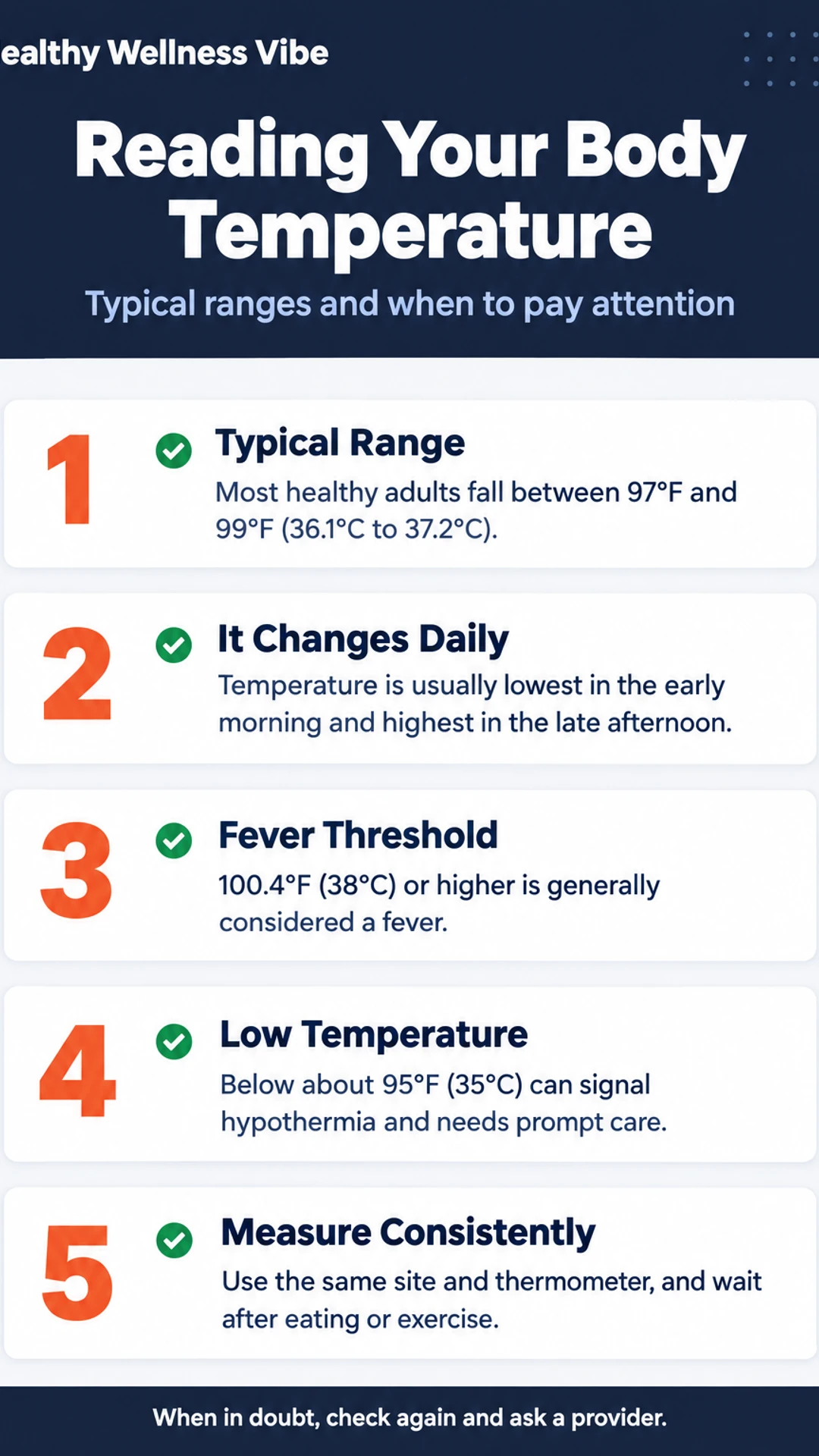
Reading ranges at a glance
| Reading | What it generally means | Next step |
|---|---|---|
| About 97°F to 99°F (36.1°C to 37.2°C) | Typical range for most healthy adults | No action needed if you feel well |
| 100.4°F (38°C) or higher | Generally considered a fever | Monitor, and contact a provider if it persists |
| Below about 95°F (35°C) | Can signal hypothermia | Seek prompt medical attention |
What Counts as a Normal Body Temperature Today
If you want a direct answer: for most healthy adults, a normal body temperature falls somewhere between about 97°F and 99°F (36.1°C to 37.2°C). The number you may remember, 98.6°F (37°C), is still widely quoted, but it is no longer treated as a fixed standard.
That figure traces back to 19th-century data, when German physician Carl Wunderlich collected a very large number of readings. Newer studies have found that typical averages often sit lower, around 97.9°F (36.6°C). Measurement methods, thermometers, and the people being measured have all changed since then, so a single number makes less sense than a range.
Why one number does not fit everyone
Your personal baseline may differ from the average. One person's normal can sit a few tenths of a degree above or below another's, and both can be perfectly healthy. A reading that is typical for you may look slightly low or high next to someone else's.
Several things can shift your reading during the day:
- Time of day: temperature is usually lowest in the early morning and tends to peak in the late afternoon or evening.
- Activity: exercise and hot weather raise it temporarily.
- Age: older adults often run a bit cooler on average.
- Measuring method: where and how you take the reading affects the result.
When a reading is worth paying attention to
A single slightly low or high number is rarely cause for alarm. It becomes more meaningful when a reading is clearly above your usual range, or when it comes with symptoms. A reading of 100.4°F (38°C) or higher is generally considered a fever, and a body temperature below about 95°F (35°C) can signal hypothermia and needs prompt medical attention. If you are unsure about a reading, check it again and speak with a doctor.
How Body Temperature Varies Through the Day and Across People
A single reading only means something if you know what your own body normally does. Body temperature is not fixed. It moves through the day, and it differs from person to person, so a number that looks alarming on one occasion may be perfectly ordinary for you.
Does the time of day change my reading?
Yes. Your temperature tends to be lowest in the early morning, often just before or after you wake, and it climbs gradually to its highest point in the late afternoon or early evening. The daily swing is usually a fraction of a degree, but it is enough to matter if you are comparing one reading to another. If you check at different times, you may see a difference that has nothing to do with illness.
What else can shift a reading?
Several everyday factors can move the number:
- Age and sex: Baseline temperature differs across people, and women's readings also shift through the menstrual cycle.
- Activity: Exercise and physical work raise temperature for a while afterward.
- Recent food or drink: A hot or cold drink, or a large meal, can temporarily change an oral reading.
- Room temperature: A cold room or a warm, stuffy one can affect skin readings.
- Skin and measurement method: Where and how you measure, and the type of thermometer, all matter.
Wait roughly 15 to 30 minutes after eating, drinking, or exercising before taking an oral reading, and keep the same method each time so your comparisons are fair.
Why can an older adult's normal reading look different?
Older adults often run a lower baseline temperature, and they may not mount a strong fever when they have an infection. A reading that seems normal can still matter, especially if it is unusually low for that person, or if other signs such as confusion, poor appetite, or feeling unwell are present. If you are caring for an older relative, it is worth talking to a medical professional about what their usual reading is, rather than relying on the standard fever cutoff alone.
How to Take an Accurate Reading
A reading only means something if you compare like with like. Taking your temperature with a different method, at a different time, or under different conditions can make a healthy body look unwell or hide a real change. The goal is consistency.
Common measurement sites include:
- Oral (under the tongue): a common everyday choice for adults.
- Underarm (armpit): usually reads lower than oral, often by about half a degree or more.
- Ear (tympanic): quick, but results depend heavily on how the device is placed.
- Forehead (temporal artery): convenient, though sensitive to skin temperature and sweat.
- Rectal: the most accurate for infants and is often used in medical settings.
When is the best time to measure?
Your temperature shifts over the course of the day, so the time you measure matters. Wait about 15 to 30 minutes after eating, drinking, or exercising, and avoid readings right after a hot shower or a cold drink. Both can skew the number for a while.
How should you track changes over time?
Stick to one site and one thermometer. Switching between methods makes small differences look like real changes. Keep a simple log with the date, the time, the method, the reading, and any symptoms you notice. Over a few weeks, that log will tell you far more than a single number.
Common places to measure temperature
| Site | How it reads | Good to know |
|---|---|---|
| Oral (under the tongue) | Common everyday reading | Wait after eating or drinking |
| Underarm (armpit) | Usually lower than oral | Often about half a degree or more lower |
| Ear (tympanic) | Quick reading | Depends on how the device is placed |
| Forehead (temporal artery) | Convenient reading | Sensitive to skin temperature and sweat |
| Rectal | Most accurate for infants | Often used in medical settings |
When a Reading Suggests a Fever or a Problem
Most of the time, the normal temperature of a healthy human body sits somewhere around 98.6°F (37°C), but that number is an average, not a rule. Your own reading may run a little higher or lower, and that is usually fine. What matters more is whether a reading is clearly outside your usual range and whether it comes with other symptoms.
What counts as a fever?
A fever is generally 100.4°F (38°C) or higher. Readings from about 99.5°F to 100.3°F may be a low-grade fever, depending on the person, their age, and the time of day. Body temperature varies throughout the day, typically running lower in the early morning and higher in the late afternoon or evening, so a single reading can mislead you. Check with a thermometer, and if you are unsure, recheck after some rest.
What about a low temperature?
A low temperature, usually below about 95°F (35°C), is a medical concern and can signal hypothermia. Watch especially for confusion, shivering that suddenly stops, or unusual drowsiness. These symptoms need prompt medical attention, not a wait-and-see approach.
When should you get care quickly?
- A high fever with a stiff neck
- Trouble breathing
- A new rash
- Confusion
- A fever that lasts several days
If your reading is only slightly off and you feel fine, it is usually worth monitoring for a day or so and noting the time and value. A small, symptom-free change is often due to normal daily variation or a minor infection.
Building Your Personal Baseline
Most people have never checked their body temperature on a day they felt well, so they have nothing to compare against when they feel off. The textbook range is a useful reference, but your own normal is often more revealing. A healthy adult's average body temperature usually sits somewhere around 36.5 to 37.2 °C (97.7 to 99 °F), and it changes throughout the day, typically running lowest in the early morning and highest in the late afternoon or evening.
On a few days when you feel well, take a reading with a basic digital thermometer, which you can get at any pharmacy for a modest price. Choose the same time of day each time, and try to take it under the same conditions, such as after you have been resting for a few minutes rather than right after a walk or a hot shower. Write down the number, the time, and how you felt. Do this for several days so you see your normal range rather than a single value.
Once you have that log, compare any later reading against your own baseline, not only against the textbook range. A reading that is slightly higher than the chart suggests may be entirely normal for you, while a smaller rise from your usual number may be worth paying attention to.
Keep in mind that a single number rarely tells the whole story. Temperatures shift with activity, a meal, a heavy blanket, or an infection that is still developing. If you feel unwell, bring your log to a clinician. A pattern over several days is often more useful to them than one reading taken in isolation, and it helps them judge whether a fever or a low reading needs attention.
Common Questions About Normal Body Temperature
Most people have been told that normal body temperature is 98.6°F (37°C), and that figure still works as a common reference point. It comes from a historical average, though, and many healthy people read a little lower or higher. A single number is less useful than the range around it, and a typical adult reading usually falls somewhere between about 97°F and 99°F (36.1°C to 37.2°C).
Is 98.6 still normal?
It is a useful average, not a strict cutoff. Your normal may be a few tenths of a degree above or below it. Body temperature also changes through the day, typically running lowest in the early morning and highest in the late afternoon or evening, and it shifts with physical activity, food, and the environment.
Is 99.5 a fever?
Usually not on its own. A reading of 99.5°F (37.5°C) is often considered a low-grade fever, but for some people it is simply their normal at that time of day. Context matters. Think about when you took it, how you feel, and whether you have other symptoms such as chills, aches, or a sore throat. If a reading stays elevated or you feel unwell, that is worth raising with a medical professional.
What is normal for seniors?
Typical readings can sit a bit lower as people get older, and the body may mount a weaker response to infection. That means a fever may be less obvious. In older adults, a small rise above their usual reading can still be significant, so it helps to know your own baseline.
Is 96.6 normal?
A reading of 96.6°F (35.9°C) falls within the lower end of many typical ranges, and a single reading at that level is often not a concern. It is worth noting if it is consistently low or comes with symptoms such as feeling cold all the time, fatigue, confusion, or slowed breathing, since very low temperatures can signal hypothermia or an underlying medical issue.
Frequently asked questions
Is 98.6 still the normal temperature?
98.6 F (37 C) is the figure most people learned, but it is an average, not a fixed number. Many healthy adults run a little lower, often between about 97 and 99 F, and body temperature shifts over the day. So 98.6 remains a useful reference point rather than a strict cutoff for everyone.
Is 99.5 considered as a fever?
A reading of 99.5 F (37.5 C) is generally considered a low-grade fever, though it is borderline. Doctors usually look at how you feel and whether the reading is part of a pattern. A single reading near 99.5 F with no other symptoms is often just watched, while a rising or persistent reading is worth mentioning to a clinician.
What is a normal body temperature for seniors?
Older adults often run slightly cooler than younger adults, and their bodies may mount a weaker fever even during an infection. Because of this, a reading that looks normal may still signal illness in an older person. Any reading that is lower than usual for that person, or any noticeable change, is worth checking with a doctor.
Is a 96.6 temperature normal?
A reading of 96.6 F (about 35.9 C) is at the low end of the typical range and is often normal, especially in the morning, in older adults, or in people who run cool. It becomes a concern if it is accompanied by shivering, confusion, drowsiness, or feeling unwell, or if a much lower reading is recorded. Repeat the measurement and check how you feel.
When should I check my temperature?
Check your temperature when you feel unwell, have chills, a sore throat, body aches, or a cough, or after exposure to someone sick. Take a reading at rest, avoiding hot or cold drinks for about 15 minutes beforehand. Note the time and method, since oral, ear, and forehead readings can differ slightly.
Wrapping up
A normal body temperature is a range, not a single number, and most healthy adults fall roughly between 97 and 99 F. A reading only matters in context: how you feel, your age, and whether the number is a change from your usual. If a reading is high, very low, or comes with symptoms that worry you, contact a healthcare professional. What is your usual resting temperature, and how do you usually take it? Share in the comments.