Healthy BodyHealthy Body Fat Percentage for Men: Typical Ranges and What Affects Them
Healthy Body Fat Percentage for Men: Typical Ranges and What Affects Them
The short answer
For most adult men, a healthy body fat percentage falls roughly between 10 and 20 percent, with athletes often lower and older men often a little higher. Ranges vary by age, fitness level and measurement method, and BMI does not capture them. Two different methods can give readings several points apart, so compare your results using the same method and conditions over time.
- Typical ranges for men: what counts as lean, average and high at different ages
- What shifts your number: age, training, sleep, and how you carry fat
- How body fat is measured: calipers, scales, tapes and scans, and why they disagree
- Why BMI falls short: where it misreads muscular and older men
- Practical ways to track progress: a routine you can keep without special equipment
If you have ever stepped on a scale, looked in the mirror, or compared yourself to someone at the gym and felt unsure where you stand, you are not alone. A single number can feel like a verdict, and conflicting advice makes it harder to know what to aim for. This guide is based on published reference ranges and common measurement practice, not on our own testing.
You do not need a lab or an expensive plan to get a useful picture. By the end, you will know what a reasonable range looks like for your age, what factors move the number, and how to measure in a way that gives you readings you can actually trust. Start with the ranges below, then work through the factors that apply to you.
What Body Fat Percentage Measures and Why It Matters
Body fat percentage is the share of your total body weight that is fat tissue. If you weigh 80 kg and 16 kg of that is fat, your body fat percentage is 20 percent. The rest is lean mass: muscle, bone, water, and organs. That simple ratio tells you more about your body composition than your total weight does, because two bodies can weigh the same and be built very differently.
Not all fat is the same. Your body needs a minimum amount of essential fat to function. It sits in the brain, nerves, organs, bone marrow, and cell membranes, and it supports hormone production. Storage fat is the rest, which your body uses for energy. Storage fat splits into two main types:
- Subcutaneous fat sits just under the skin, where you can pinch it.
- Visceral fat wraps around the internal organs in the abdomen. It is the type more closely linked to metabolic health concerns.
This is why a man of average weight with a larger waist can carry more visceral fat than a heavier man who is more muscular. Muscle is denser than fat, so a man who trains regularly often carries more weight for his height while holding a lower body fat percentage. Body mass index cannot tell these two men apart, which is one reason body fat percentage is a useful complement to it.
Typical Healthy Body Fat Ranges for Men
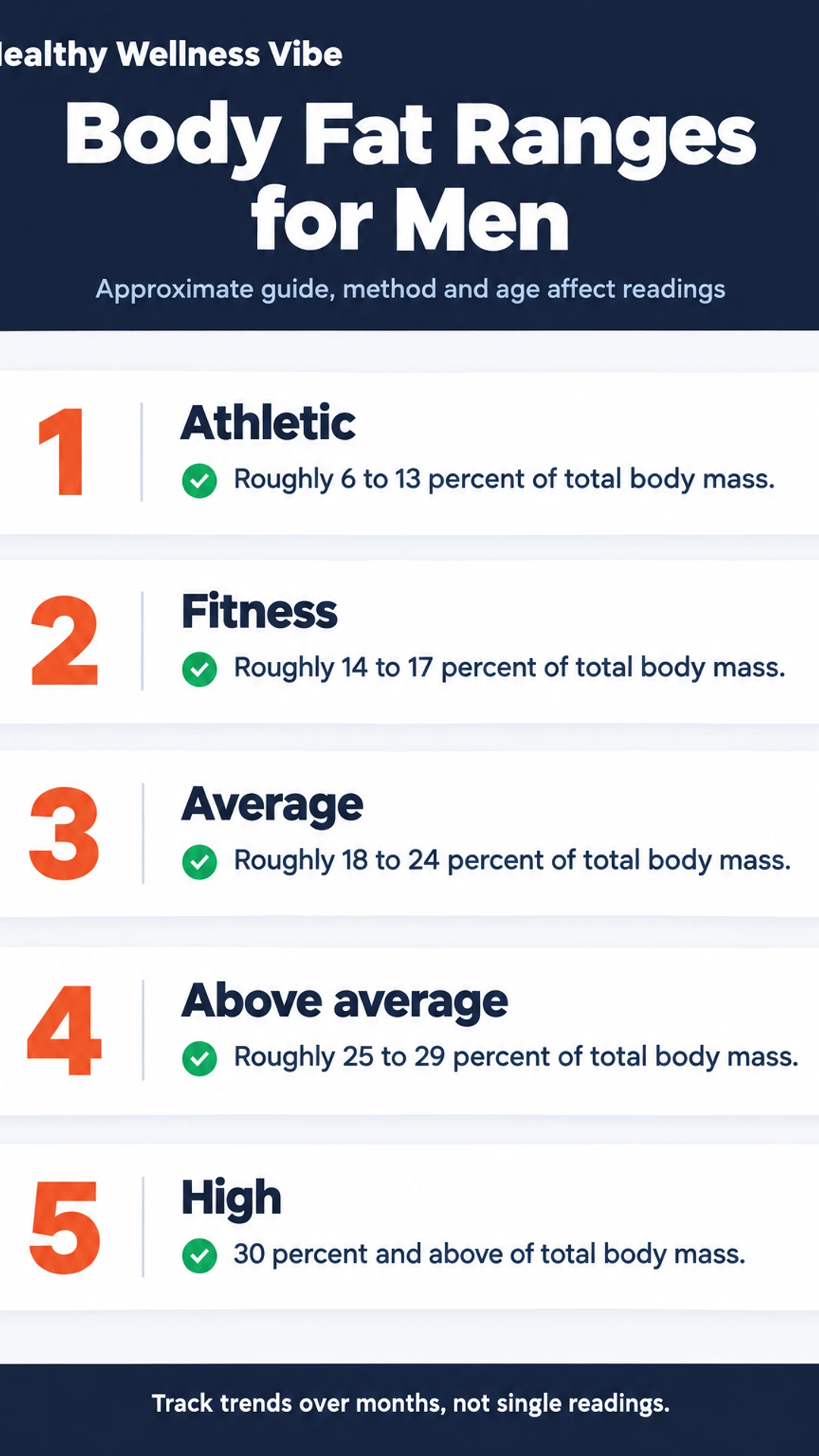
Body fat percentage is the share of your total body mass that is fat, as opposed to muscle, bone, water and organs. Different sources draw the category lines in slightly different places, so treat the bands below as approximate guides rather than fixed cut-offs. Your results from a scale, calipers or a body composition analysis can differ by several points depending on the method.
- Athletic: roughly 6 to 13 percent
- Fitness: roughly 14 to 17 percent
- Average: roughly 18 to 24 percent
- Above average: roughly 25 to 29 percent
- High: 30 percent and above
Why does the commonly cited healthy zone for most men sit between about 10 and 20 percent? Because in that range there is enough stored fat to fuel daily life and support normal hormone function, while still keeping metabolic and cardiovascular risk lower than at higher levels. Men usually carry less essential fat than women, so the lower bound sits lower.
Going much below that band can backfire. Very low levels are often linked with low energy, slower recovery from training and changes in hormone balance. Higher levels raise the risk of conditions such as high blood pressure and type 2 diabetes. Your body fat percentage is one useful health marker alongside your waist measurement, bmi, activity level and blood results, not a score to chase.
Body fat ranges for men at a glance
| Category | Approximate body fat |
|---|---|
| Athletic | Roughly 6 to 13 percent |
| Fitness | Roughly 14 to 17 percent |
| Average | Roughly 18 to 24 percent |
| Above average | Roughly 25 to 29 percent |
| High | 30 percent and above |
How Age, Fitness and Muscle Change Your Range
The general ranges for men are a starting point, not a verdict. Your own number shifts with a few factors, and understanding them helps you read your results sensibly.
Age is the first one. Muscle mass tends to decline gradually as adults get older, and the body's fat stores often shift toward the midsection. Because of this, healthy ranges for older men sit modestly higher than those for younger men. A result that looks slightly high at 25 may be reasonable at 55, so compare yourself with your age group rather than an ideal of a lean twenty-year-old.
Strength training changes the picture in a way the scale does not show. When you lift weights regularly, you can build lean tissue and lose fat at the same time, so your body weight may barely move while your body composition improves. This is why two men of identical weight can have very different body fat percentage results. If you start training and your weight stays flat, that is not a sign of failure. Your fat percentage may well be falling.
Muscle also explains why BMI can mislead you. BMI uses only height and weight, so it cannot tell muscle from fat. A muscular man can carry a high BMI and still look lean, with a body fat percentage well within a healthy range. In that case BMI overstates his fatness. If you are an active, well-built man, treat BMI as a rough screen and rely more on a body fat measurement and how you feel.
Use your results as one input among several, and look at trends over months rather than a single reading.
How to Measure Body Fat at Home and in Clinics
Knowing your body fat percentage gives you a more useful picture of your health than body weight alone, because two men of the same weight can have very different amounts of fat and muscle. The tricky part is that every measurement method has trade-offs in accuracy, cost and convenience. The best method is the one you can repeat the same way each time.
Here is how the main options compare:
- Skinfold calipers: A trained tester pinches fat folds at set sites and applies a formula. Cheap to buy, but accuracy depends heavily on who measures and where.
- Waist-to-height ratio and tape formulas: Divide your waist circumference by your height. Needs only a tape measure and is very practical to repeat, though it estimates fat distribution rather than a precise percentage.
- Bioelectrical impedance scales: Home scales send a small current through the body. Convenient and cheap, but hydration and recent meals shift the reading considerably.
- DXA scans: A clinic scan that separates bone, lean mass and fat. The most accurate option here, but costly and not always easy to book.
Home methods typically carry a margin of error of several percentage points, so treat them as a guide to trends. A steady drop over months tells you more than any single reading.
How can I get more consistent readings?
Standardise your conditions so that changes reflect your body, not your routine:
- Measure at the same time of day, ideally after waking and before eating.
- Keep your hydration similar each time, since water shifts impedance readings.
- Avoid measuring right after heavy training, which temporarily changes fluid balance.
- Use the same method and, where possible, the same device.
Common ways to measure body fat
| Method | Where it is used | Main trade-off |
|---|---|---|
| Skinfold calipers | Home or trained tester | Cheap, but depends on who measures |
| Waist-to-height tape | Home | Practical to repeat, estimates rather than exact |
| Bioelectrical impedance scale | Home | Convenient, but hydration and meals shift readings |
| DXA scan | Clinic | Most accurate here, but costly and harder to book |
Why Readings Disagree and How to Read Your Numbers
If you have searched for a healthy body fat percentage for men, you have probably found several different answers. That is not a sign that anyone is careless. Sites often quote different ranges because they use different reference populations (athletes, the general public, or a specific age group) and different definitions of what counts as "healthy" versus "average." Measurement method matters too. Calipers, bioelectrical impedance scales and DEXA scans can give readings that differ by several points on the same person, so a range built from one method will not line up neatly with another.
Rather than chasing the perfect number, use your body fat percentage as one piece of a wider picture. Combine it with:
- Waist circumference. Excess fat around the abdomen is linked with more health risk than fat elsewhere. Measure at the navel, relaxed, and track it over time.
- Waist-to-height ratio. Divide your waist by your height in the same units. A ratio below 0.5 is a commonly used guide, and it works for many adult men without any special equipment.
- How you feel and perform. Energy, sleep, recovery after training and everyday fitness tell you things a single figure cannot.
Also remember that a single reading is less important than the trend. Scales and home devices shift with hydration, meals and time of day, so a reading taken after a salty dinner can look worse than it really is. Measure under similar conditions, such as first thing in the morning, and look at the average over several weeks. A slow, steady downward or stable trend, with a healthy waist and good energy, is a far more useful signal than one number you saw on a given Tuesday.
Simple Habits to Move Toward a Healthier Range
If your goal is a healthier body fat percentage for men, you do not need a gym membership or an expensive meal plan to make progress. Most of what moves body composition over time is repeatable: what you eat most days, how much you move, and how well you sleep. Small changes you can keep up beat strict plans you abandon after a week.
What can I eat on a tight budget?
Build most meals around protein and fiber, and keep the ingredients cheap and shelf-stable. Eggs, dried or canned beans, lentils, oats, frozen vegetables and canned fish like tuna or sardines cover a lot of ground for very little money. A simple pattern works well:
- Scrambled eggs with frozen spinach and a slice of toast
- A pot of lentils or beans with frozen vegetables and rice
- Oats cooked with milk or water, topped with fruit or peanut butter
- Canned fish on a salad or in a wrap with whatever vegetables you have
Cook a larger batch once or twice a week and portion it out. This saves time and money, which matters more than finding the perfect recipe.
How much should I move each day?
For most people, the core routine is regular walking plus bodyweight strength work at home. Aim for a daily walk you can actually fit in, and add two or three short strength sessions a week using push-ups, squats, lunges, glute bridges and rows with a backpack. You do not need equipment for any of it. Consistency over several months will do far more for your training results than occasional hard sessions.
Does sleep really matter?
Yes. Irregular sleep makes it harder to control hunger and recover from training. Try to go to bed and wake up at roughly the same times, even on weekends, and give yourself a wind-down routine. If you are a student or shift worker, consistency within your own schedule still helps.
Should I make big changes all at once?
Usually not. Pick one or two habits, such as a daily walk and a protein-rich breakfast, and build from there. Gradual change is easier to sustain, and it gives you a clearer sense of what is working. For daily habit ideas, see our Healthy Body guide, and to estimate a reasonable range for your own height and frame, try the Healthy Body Weight Calculator.
Frequently asked questions
What does 20 body fat look like on a woman?
At around 20 percent body fat, a woman typically looks lean and fit with visible muscle definition in the arms and shoulders, though the exact look varies with frame size, where fat is stored and muscle mass. Few people can tell the number from appearance alone, so a visual guess is a rough guide rather than a measurement.
What's the easiest way to measure body fat?
The simplest method is a tape measure: record your waist, neck and, for women, hips, then compare against a body fat estimation formula. Bathroom smart scales and handheld devices are also convenient. For consistency, measure at the same time of day, under the same conditions, and track the trend over weeks rather than reacting to one reading.
What does fat look like in the body?
Body fat comes in two main forms. Subcutaneous fat sits just under the skin and is the soft layer you can pinch, usually on the belly, hips and thighs. Visceral fat wraps around internal organs in the abdomen and cannot be seen or pinched. Visceral fat is the type more closely linked to health risks.
What is a healthy body fat percentage for a 55 year old woman?
Commonly cited ranges for women in their fifties are roughly 23 to 34 percent, with the lower part of that band often associated with good health. Body fat tends to rise with age even when weight stays the same, so a reading that is normal at 25 may still be worth discussing with a doctor if it changes quickly.
What is a healthy body fat percentage for men?
For most adult men, a healthy range is often given as about 10 to 20 percent, with athletes sometimes lower and men over 50 sometimes slightly higher. Measurement method, age, height and muscle mass all affect the number, so treat any range as a starting point and look at your overall health markers too.
Wrapping up
A healthy body fat percentage for men usually falls somewhere around 10 to 20 percent, but the number only means something alongside your age, muscle mass and how you measured it. Pick one consistent method and watch the trend over time rather than chasing a single reading.
What method do you use to track your body composition, and has the number told you anything useful? Share your experience in the comments.