Healthy BodyHealthy Body Weight for Women: Ranges and the Factors That Shape Them
Healthy Body Weight for Women: Ranges and the Factors That Shape Them
The short answer
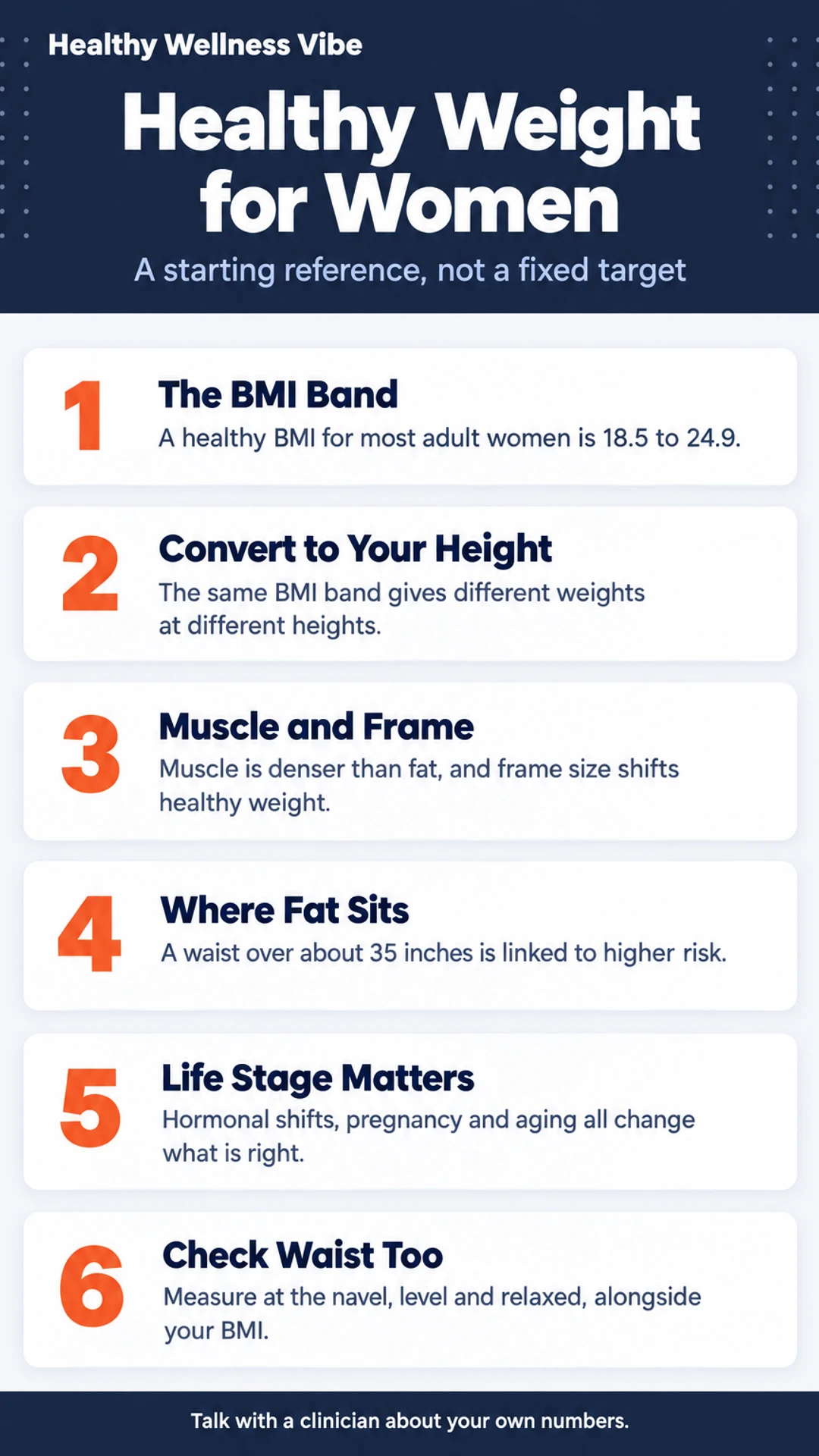
For most adult women, a healthy weight is generally a body mass index (BMI) between 18.5 and 24.9. BMI is weight in kilograms divided by height in metres squared. Because height is the main input, the healthy range in pounds or kilograms differs by height. Age, muscle mass, frame size and where fat is stored can shift what is right for an individual, so the range is a starting reference rather than a fixed target.
Here is what this guide covers:
- The BMI range and how it is calculated: what the numbers mean and where they stop being useful.
- Converting the range to pounds or kilograms: how the same BMI band produces different weights at different heights.
- Age and life stage: why the best range for a woman in her twenties may not suit her at fifty.
- Muscle, frame and body composition: how two women of the same height can have very different healthy weights.
- Where fat sits: why waist size can tell you something the scale does not.
- Using the range sensibly: how to treat it as a reference and when to talk to a clinician.
If you have ever looked up a weight chart, felt either reassured or worried by the result, and wondered whether it actually applies to you, you are not alone. Most charts give one number or one band and leave you to guess how it fits your own build, age and daily life. That gap is where people get confused, and it is where careless advice can do real harm.
This guide aims to close that gap. You will see how the healthy range is set, which personal factors move it up or down, and how to apply it to your own situation without becoming fixated on a single figure. Along the way we will point you to related pages in this hub, including the BMI calculator and the body fat percentage guides, so you can check your numbers from several angles.
This guide is based on published health guidance and what researchers and clinicians commonly report, not on our own testing.
How a Healthy Weight Range Is Set
Most people have heard a "healthy weight range," but few know where the numbers come from. The starting point is the body mass index, usually shortened to BMI. BMI is a simple index that compares your weight to your height. You calculate it by dividing your weight in kilograms by your height in metres squared. Major health bodies, including the World Health Organization, treat a BMI from 18.5 to 24.9 as the normal or healthy band for adults. Below that is considered underweight, and from 25 upward is overweight or higher.
Once you have that band, the weight range for any height is simple arithmetic. Take your height, square it, and multiply by 18.5 and then by 24.9. In imperial units, the same calculation uses a conversion factor of 703, so the result comes out in pounds. For a woman who is 5 feet 5 inches tall, the band works out to roughly 109 to 147 pounds.
You may notice that different charts give slightly different numbers for the same height. That usually comes down to rounding, the exact conversion factor used, or whether a chart is built on the full 18.5 to 24.9 band or a narrower one. None of these differences is a sign that one chart is right and another is wrong.
It also helps to remember what the range is. It describes patterns seen across large groups of people, linking body weight to health risks such as heart disease and type 2 diabetes. It is not a personal ideal or a target you must hit. BMI also cannot tell muscle mass from body fat, so a very muscular person may land in the overweight band without carrying excess fat. Treat the range as a reference point, and talk with a medical professional if you want to know what it means for you.
Healthy Weight Ranges by Height and Age
Most people want a simple number to start with, so here is a practical reference. The ranges below use the healthy weight band that is widely used for adult women, based on a body mass index of 18.5 to 24.9. Remember that a range is a guide, not a target you must hit exactly.
- 4 ft 10 in (147 cm): about 91 to 119 pounds (41 to 54 kg)
- 5 ft 0 in (152 cm): about 98 to 128 pounds (45 to 58 kg)
- 5 ft 3 in (160 cm): about 108 to 141 pounds (49 to 64 kg)
- 5 ft 6 in (168 cm): about 115 to 150 pounds (52 to 68 kg)
- 5 ft 9 in (175 cm): about 126 to 164 pounds (57 to 74 kg)
To read the table, find your height in the left column, then look across to see the weight band. If you measure in centimetres, use the centimetre figure in brackets. To convert yourself, multiply inches by 2.54 to get centimetres, and multiply pounds by 0.454 to get kilograms.
Does healthy weight change as I get older?
Yes, and this matters most for older women. With age, muscle mass tends to decline, and body fat often shifts toward the midsection. Two women of the same height and weight can have quite different amounts of body fat. For that reason, many clinicians treat the range as a starting point and look at waist size, strength, and overall health too. If you are over 65, a slightly higher weight within the range is often considered acceptable, and a conversation with your doctor can help you interpret your own numbers.
Quick Reference: Healthy Weight by Height
| Height | Healthy weight (pounds) | Healthy weight (kilograms) |
|---|---|---|
| 4 ft 10 in (147 cm) | About 91 to 119 | About 41 to 54 |
| 5 ft 0 in (152 cm) | About 98 to 128 | About 45 to 58 |
| 5 ft 3 in (160 cm) | About 108 to 141 | About 49 to 64 |
| 5 ft 6 in (168 cm) | About 115 to 150 | About 52 to 68 |
| 5 ft 9 in (175 cm) | About 126 to 164 | About 57 to 74 |
Personal Factors That Shift the Range
A healthy weight range is a starting point, not a verdict on your body. Several personal factors can move where you sit within it, or above or below it, and knowing them helps you read your numbers more sensibly. Your body mass index is a rough screen, and it does not see everything, so it helps to understand what else is going on.
Why does being active change my healthy weight?
Muscle is denser than fat. Muscle mass and bone density both add to your total weight, so a woman who lifts, runs, or does manual work may weigh more than a sedentary woman of the same height and still be in good health. Your scale number can rise while your body composition improves. If you are strong and active, a weight near the upper end of the range is often nothing to worry about.
How do frame size and build affect my range?
Your frame, the underlying structure of your bones, is part of why two women of the same height can look and weigh quite differently. A simple check is your wrist: wrap your thumb and middle finger around it. A small overlap suggests a small frame, a gap suggests a medium frame, and no overlap suggests a large one. Hip width, measured at the widest point of your hips, gives a second clue. Your frame is a fixed trait, so aim for a range that fits your build rather than a single target.
Where your fat sits matters, not just how much
Fat stored around the middle, known as visceral fat, carries more metabolic risk than fat on the hips and thighs. This is why waist size is worth tracking. Measure at the navel, keep the tape level, and breathe out before reading. A waist larger than about 35 inches for women is linked to higher risk of heart disease and type 2 diabetes, so a waist measurement can flag a concern even when your total weight looks reasonable.
How do life stages change things?
- Puberty: Weight rises as the body builds fat and muscle, and this is normal. Growth charts, not adult ranges, apply to children and teens.
- Pregnancy: Weight gain is expected and planned with your care team.
- Perimenopause and menopause: Hormonal shifts often move fat toward the waist and slow muscle loss, so the same weight can mean a different body composition than it did earlier.
The Limits of BMI and Better Complementary Measures
BMI is a quick screen, not a verdict. It divides weight by height squared, so it cannot tell muscle from fat, and it says nothing about where your fat sits. Two women with the same body mass index can have very different body composition and very different health risks. That is why the number is most useful as a starting point, and why you should add one or two simpler checks.
How do I check my waist?
Waist size is one of the most practical measures you can take at home, and it needs no equipment beyond a flexible tape. Here is how to measure it:
- Stand relaxed with your feet together and breathe out gently.
- Find the top of your hip bone and the bottom of your lowest rib, then measure around the midpoint, level with your navel.
- Keep the tape snug but not pressing into the skin, and read it without holding your breath.
Waist-to-height ratio takes this a step further. Divide your waist by your height, using the same units for both. A ratio below 0.5 is generally associated with lower risk. If you measure in inches, a 64-inch-tall woman with a 30-inch waist has a ratio of about 0.47.
Why do women carry more body fat at the same weight?
Women typically carry more body fat than men at the same weight, largely because of hormonal differences and where fat is stored for pregnancy and breastfeeding. Body fat percentage captures this directly, usually through a smart scale, skinfold calipers or a clinic scan. Treat readings from home devices as trends rather than exact figures.
Which everyday signals should I track?
Numbers are only part of the picture. Notice how you feel and function: your energy through the day, how far you can walk or climb stairs, how your clothes fit, and your blood pressure if you can check it. If these change for the worse while your weight stays the same, talk to a doctor. Any concern about weight-related conditions is worth a medical conversation.
Health Risks Linked to Weight Outside the Range
A weight range is a guide, not a line you either cross or stay behind. Still, it helps to know what tends to go along with weight sitting well above or below it, so you can spot patterns early and act sensibly.
What are the risks of being above the range?
When body mass index (BMI) runs above the healthy range, the risk of several conditions generally rises. These include:
- Raised blood pressure
- Higher blood sugar, which can progress toward type 2 diabetes
- Unfavourable blood fats, such as higher triglycerides
- Joint strain and reduced mobility
Extra body fat, especially around the waist, is a larger part of this picture than the scale alone. Obesity is the term used when excess body fat reaches a level that carries clear health risks.
What are the risks of being below the range?
Weight below the range is less often discussed, but it matters. Common signs include low energy, feeling cold, irregular periods, and gaps in nutrients such as iron, calcium, and vitamin D. Over time, low body mass can also weaken bones and reduce muscle mass.
Why does the whole picture matter more than one number?
BMI does not measure body fat directly, and it cannot tell muscle from fat. Age, height, waist size, fitness, and family history all shape what a given number means for you. Use a BMI calculator as a starting point, then look at the full picture.
When should you see a doctor instead of adjusting on your own?
Book an appointment rather than trying to fix things alone if you notice:
- Unplanned weight change of several pounds over a few weeks
- Persistent tiredness, dizziness, or fainting
- Symptoms such as excessive thirst or frequent urination
- Missed periods, or a sudden change in your cycle
- Chest pain or shortness of breath during routine activity
A medical professional can check blood pressure, blood sugar, and other markers before you decide on changes.
Weight Above or Below the Range
| Weight direction | Common associated risks | Common signs to watch |
|---|---|---|
| Above the range | Raised blood pressure, higher blood sugar, unfavourable blood fats | Joint strain, reduced mobility |
| Below the range | Weakened bones, reduced muscle mass | Low energy, feeling cold, irregular periods |
What to Do If Your Number Looks Off
A number from a scale or a calculator is only a starting point. Before you decide your weight is too high or too low, look at the personal factors that can shift a healthy weight range for you.
Consider these before drawing a conclusion:
- Age. Muscle mass tends to decline with age, so an older adult may carry a different healthy weight range than a younger one.
- Height and frame. Taller people and those with a larger frame usually sit higher on any weight range.
- Muscle versus body fat. Someone who lifts weights may weigh more and still have a healthy body fat level.
- Pregnancy, postpartum recovery, or breastfeeding. These change what is normal for you right now.
- Medications and existing conditions. Some medicines and health conditions affect weight directly.
- Family history and where you carry weight. Waist size can tell you as much as the scale does.
Why does one weigh-in tell me so little?
Your weight can swing by a few pounds in a single day because of water, salt, food in your gut, hormones, and bowel contents. A single reading captures that noise. Weigh yourself at about the same time each morning, and look at the average over one to two weeks instead of any one day.
When should I talk to a doctor?
Book an appointment if your weight changes quickly without a clear reason, if you have symptoms such as fatigue or breathlessness, or if a weight-related health risk runs in your family. Bring your recent weight readings, your height, a list of medications, and any questions you want answered.
Where do I get a specific estimate?
Use a healthy body weight calculator to get a range based on your height, and use a BMI calculator for a quick index check. BMI is a rough screen, not a diagnosis, so read it alongside the factors above.
Frequently asked questions
Is 140 pounds fat for a 5'4" female?
No. At 5'4", 140 pounds gives a body mass index of about 24, which falls within the standard healthy range of 18.5 to 24.9. Weight alone cannot show body fat, though. Muscle mass, frame size, and where fat is stored all change what a number on the scale means for you.
What is a good weight for my height and age?
A common starting point is the body mass index range of 18.5 to 24.9, which applies to most adult women regardless of age. For a rough sense of the weight this corresponds to, multiply your height in inches squared by 18.5 and by 24.9. Your waist size, energy, and how you feel also matter.
Is 5'5" and 150 pounds overweight?
At 5'5", 150 pounds gives a body mass index of about 25, which sits just above the 18.5 to 24.9 range. That places it in the overweight category by that single measure. It is a borderline reading, so waist measurement, activity level, and muscle mass are worth considering before drawing conclusions.
Is 160 overweight for 5'2" female?
At 5'2", 160 pounds gives a body mass index of about 29, which is in the overweight range of 25 to 29.9. A large frame or substantial muscle can make this number less meaningful, so it is worth checking waist size and talking with a doctor who can look at your full health picture.
Do healthy weight ranges differ for women?
The main body mass index range is the same for women and men, but women typically carry more body fat at a given weight. Hormones, pregnancy history, and life stage shift where fat sits and how much a woman carries, so the same number can mean different things for different women.
Wrapping up
A healthy weight range is a guide, not a verdict on your body. The body mass index range of 18.5 to 24.9 is a useful starting point for most women. Frame size, muscle, waist measurement, and life stage all shape what your number means. What has your experience been with weight ranges? Share your thoughts in the comments.