Healthy BodyHealthy Body Weight Calculator: How to Estimate Your Healthy Range
Healthy Body Weight Calculator: How to Estimate Your Healthy Range
The short answer
A healthy body weight calculator estimates a weight range for your height, usually based on BMI, where 18.5 to 24.9 is the standard healthy category for adults. Enter your height and weight, and the calculator shows the weight range that matches that BMI band for your height. Ideal body weight formulas give a single estimate instead. Both are guides, not diagnoses, and they do not account for muscle mass or body composition.
This guide is based on published formulas and what users commonly report, not on our own testing.
If you have typed your height into a box and felt confused by the number that came back, you are not alone. Most people want a simple answer to a question that is actually more layered: what weight is right for me? A calculator can give you a starting point, but a single number on a screen rarely tells the whole story.
Here is what this article covers:
- Entering your numbers correctly: which units to use and where people commonly make mistakes.
- Reading a BMI-based range: how the 18.5 to 24.9 band turns into pounds or kilograms for your height.
- Comparing ideal body weight formulas: why they give one figure and how that differs from a range.
- What the result misses: muscle, frame size, age, and body composition.
- Using the result sensibly: how to treat a calculator as one input alongside how you feel and what your clinician says.
I have found that the most useful way to read these tools is as a rough map rather than a verdict. The sections ahead walk you through each step, so you can decide for yourself what the result means for your daily routine and your next steps with a healthcare professional.
How to Use a Healthy Body Weight Calculator Step by Step
Most healthy body weight calculators work the same way, so the steps below will apply to whichever one you open. Set aside two minutes and follow them in order.
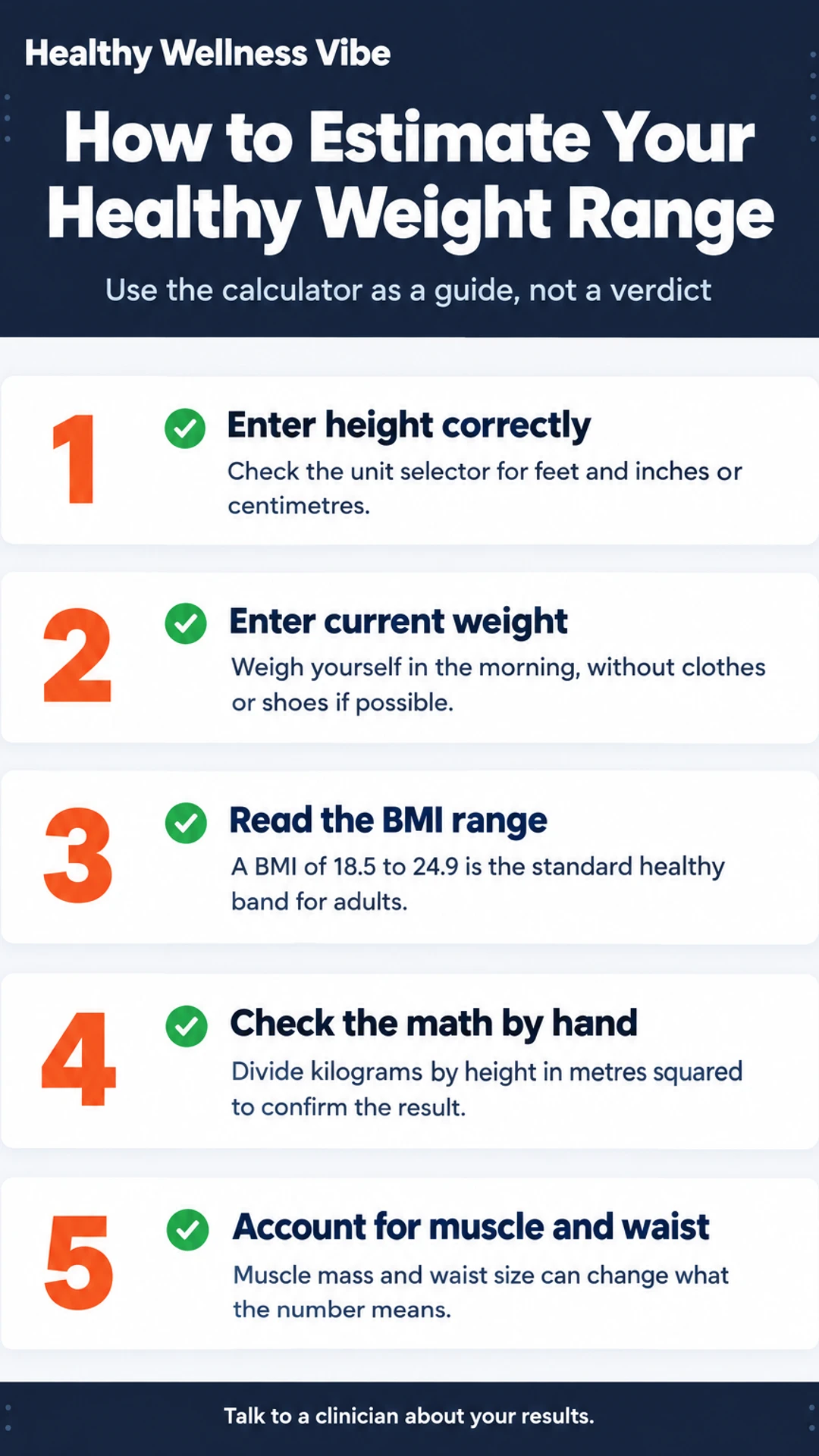
Enter your height. Use feet and inches or centimetres, and check the unit selector before you calculate. Entering 5.8 when the tool expects centimetres is one of the most common mistakes, and it produces a result that looks plausible but is wrong.
Enter your current weight. Weigh yourself in the morning, after using the toilet and before eating or drinking much. Use pounds or kilograms, matching the unit the calculator asks for. Clothes and shoes add weight, so weigh yourself without them if you can.
Read the healthy range. Note whether the result is a BMI range or a formula estimate. A BMI range is based on your height and weight alone. A formula estimate, such as those derived from older ideal body weight equations, may also use sex or frame size. These are different methods and can give different numbers.
Check the arithmetic by hand. Repeat one step yourself. For metric, divide your weight in kilograms by your height in metres squared. For imperial, multiply pounds by 703 and divide by height in inches squared. If your answer matches the calculator, the inputs were read correctly.
Remember that a calculator gives an estimate, not a verdict on your health. It does not measure body fat or muscle, so a person with high muscle mass can fall outside the range while being healthy.
BMI range versus ideal body weight formula
| Method | What it gives | Inputs it uses |
|---|---|---|
| BMI range | A weight band | Height and weight |
| Ideal body weight formula | A single estimate | Height, plus sex or frame size |
Working the Math by Hand: A Worked Example
Most healthy body weight calculators use the same underlying formula, so it helps to see it once on paper. The method is a simple version of the body mass index, which divides weight by height squared. Working it backwards gives you a weight range.
Start by converting your height to metres. If you measure in feet and inches, multiply the feet by 0.3048 and the inches by 0.0254, then add them together. Next, square that height figure, meaning multiply it by itself. Then multiply that result by 18.5 and by 24.9. Those two numbers are the lower and upper ends of the healthy range in kilograms.
Here is how it works for someone who is 5 feet 4 inches tall, which is about 1.63 m:
- Height squared: 1.63 × 1.63 = 2.66 m²
- Lower end: 2.66 × 18.5 = about 49.2 kg
- Upper end: 2.66 × 24.9 = about 66.2 kg
So the healthy range for this height is roughly 49 to 66 kg. To place 150 lbs on that scale, convert it first. 150 lbs is about 68 kg, which sits just above the upper end, so this person would fall in the overweight band on a standard body mass index calculation.
Why Does the Range Shift for Shorter and Taller People?
Because height is squared, the range grows faster than height does. A taller person has a much wider range in kilograms than a shorter one, and the same weight can land in different categories depending on height. This is why you cannot compare your weight to a fixed number and get a meaningful answer.
How Do I Convert Kilograms Back to Pounds?
If the calculator returns kilograms and you think in pounds, multiply kilograms by 2.2046. For example, 49.2 kg × 2.2046 is about 108 lbs, and 66.2 kg × 2.2046 is about 146 lbs. Remember that a range is an estimate, not a target, and it does not measure muscle or body fat directly.
Healthy Weight Ranges by Height: A Quick Reference
If you want a fast answer without doing any math, a height and weight chart is the easiest place to start. The ranges below come from the standard BMI categories, where a BMI of 18.5 to 24.9 is considered the healthy weight range for most adults. They are rounded, so treat them as a guide rather than exact cut-offs.
Healthy weight ranges for adults at common heights
- 5'0" (152 cm): about 95 to 127 lb (43 to 58 kg)
- 5'3" (160 cm): about 105 to 140 lb (48 to 64 kg)
- 5'6" (168 cm): about 115 to 154 lb (52 to 70 kg)
- 5'9" (175 cm): about 125 to 169 lb (57 to 77 kg)
- 6'0" (183 cm): about 136 to 183 lb (62 to 83 kg)
How to read this chart
These figures apply to adults aged 20 and over. For children and teenagers, growth changes the picture, and a pediatric BMI-for-age chart is used instead. For older adults, many clinicians look at the same range but weigh it against muscle loss, bone density and overall health, so a person in their 70s may be fine slightly above the standard range.
Use the table as a starting point, not a verdict. A weight that falls outside the range does not automatically mean a health problem, and a weight inside it does not guarantee good health. Body composition, muscle mass, waist size, blood pressure and blood tests all matter. If the number surprises you, talk to a doctor rather than making a drastic change.
For a fuller explanation of how these categories are set and what they do and do not measure, see the BMI page in this hub.
What the Result Does and Does Not Tell You
A healthy body weight calculator gives you a number range based mainly on your height and weight. It is a useful starting point, but it cannot see what your body is made of. Weight includes bone, water, organs, and both muscle and body fat, and a simple calculation cannot tell these apart.
Why can a muscular person come out "overweight"?
If you lift weights, play sports, or do physical work, you may carry more muscle mass than the average person of your height. Muscle is dense, so you can weigh more and still have a lean, healthy body. In that case the calculator may place you above the range even though your body fat is low. Treat the result as a prompt to look at more information, not as a verdict.
Why does the same number mean different things?
The same weight can suit one person and not another, depending on:
- Frame size: Broader or narrower bones change how much a person naturally weighs.
- Age: Body composition shifts over the years, often with less muscle and more fat.
- Sex: Women typically carry a higher proportion of body fat than men at the same weight.
- Ethnicity: Research shows that health risks can appear at different weights and body shapes across populations, so a single range may fit some groups better than others.
Why check your waist too?
Waist measurement adds information that weight alone cannot. Fat stored around the middle is linked to higher risk of heart disease and other conditions, even when total weight looks normal. Measure your waist at the level of your navel, relaxed and without pulling in, using a flexible tape. Together with the calculator result, it gives you a clearer picture.
What the calculator cannot do
The calculator does not diagnose any condition, and it does not replace advice from a doctor or other qualified health professional. If you have concerns about your weight, your health, or a child's growth, speak with a clinician who can consider your full medical history.
What the result can and cannot capture
| Factor | Effect on the result | Notes |
|---|---|---|
| Muscle mass | Can push a healthy person above range | Muscle is denser than fat |
| Frame size | Changes what is naturally normal | Broader or narrower bones |
| Age | Body composition shifts over time | Less muscle, more fat, often |
| Waist size | Adds information weight cannot show | Fat around the middle matters |
Common Mistakes That Skew Your Result
A healthy body weight calculator can only work with the numbers you give it. If those numbers are off, the output will look precise and still mislead you. Most errors come from a handful of simple habits, and you can avoid them with a little care.
Are you mixing up your units?
This is the most common slip. A calculator may ask for weight in kilograms and height in centimeters, or in pounds and feet and inches. Entering 165 pounds into a field that expects kilograms gives a result that is far too high. Check the unit label on every field before you press calculate, and make sure both values use the same system.
Does it matter how and when you weigh yourself?
Yes. Heavy clothes, boots, or a jacket can add several pounds, and so can weighing right after a large meal or a lot of fluid. Your weight also tends to shift through the day. For a consistent reading, weigh yourself in the morning after using the toilet, before eating, and in light clothing without shoes.
Are you using a measured height or a guessed one?
Many people estimate their height from memory, which is often a little off, especially as the years pass. Height feeds directly into the formula, so a small error there can change the result noticeably. Stand against a wall with your heels, back, and head touching it, mark the spot, and measure from the floor to the mark.
Are you comparing one reading to a range?
A single weigh-in can swing by a pound or two from day to day, so one number tells you little. Instead, record your weight a few times a week for several weeks and look at the average trend. Compare that trend to the range the calculator gives you, not one morning's figure.
What to Do Next With Your Range
A calculator gives you a number or a band, and that is where its job ends. What you do with it is up to you, and for most people the answer is less dramatic than they expect.
If you fall inside the range, the goal is simply to keep doing what works. Eat regular meals rather than skipping and then overeating. Aim for enough sleep, which for most adults is around seven to nine hours. Move your body every day, even if it is just a 20-minute walk between classes or work. These habits support your health whatever the scale says.
If you fall outside the range, slow down before you change anything. Measure your waist with a soft tape at the level of your belly button. Waist size is often a more useful signal than weight alone, because it reflects where fat sits in the body. Also ask yourself how you feel: your energy, your sleep, your mood, and how your clothes fit. A calculator cannot see muscle mass, so someone who lifts regularly may read as higher than they really are.
How do you set goals without burning out? Pick one small change you can keep for a few weeks, such as adding a vegetable to your lunch or walking after dinner. Weigh yourself no more than once a week, at the same time of day, and look at the trend over several weeks. Daily weight swings of a kilogram or more are normal and mostly reflect water and food in your gut.
When should you see a doctor? Make an appointment if you lose or gain weight without trying, if you have a medical condition that affects weight, or if you are worried about your eating or feel pressure to restrict food. A clinician can give advice that fits your own body, age, and history.
Frequently asked questions
What is the ideal body weight for my age and height?
There is no single ideal weight. Height-based formulas such as the Hamilton-Robinson or Devine methods give a reference weight, but they ignore muscle, frame size and body composition. A healthy weight range, usually tied to a BMI of 18.5 to 24.9 for adults, is more useful than one number. Your doctor can help you interpret it for your situation.
How do I calculate my ideal body weight?
One common method is the Devine formula: for men, 50 kg plus 2.3 kg for each inch over 5 feet; for women, 45.5 kg plus 2.3 kg per inch over 5 feet. Convert 5 feet 4 inches for a woman: 45.5 + 9.2 = about 54.7 kg, or roughly 121 lbs. Treat the answer as a rough reference, not a target.
Is 150 lbs overweight for 5'4"?
At 5'4", 150 lbs (about 68 kg) gives a BMI of roughly 25.8, which falls in the overweight category under standard BMI cutoffs. BMI does not measure body fat directly, though. Someone with a lot of muscle may carry that weight healthily. Waist size, activity level, blood pressure and blood sugar give a fuller picture.
What is a healthy weight for my height?
For most adults, a healthy weight range is the one that corresponds to a BMI between 18.5 and 24.9. At 5'4", that works out to roughly 108 to 145 lbs. The range is a starting point. Your waist measurement, energy, fitness and health markers matter as much as the number on the scale.