Healthy BodyHealthy Body Mass Index for Women: The Range and What It Really Tells You
Healthy Body Mass Index for Women: The Range and What It Really Tells You
The short answer
For adult women, a healthy body mass index is generally between 18.5 and 24.9. Below 18.5 is classed as underweight, 25 to 29.9 as overweight, and 30 or above as obesity. BMI is a screening tool, not a diagnosis, so age, height, muscle mass and overall health can change what a given number means for an individual woman.
If you have ever looked up your BMI and felt unsure what the number actually says about you, you are not alone. Online charts disagree, the categories sound clinical, and nobody explains what to do if the result doesn't match how you feel or what your clothes tell you. That confusion is worth clearing up before you draw any conclusions.
This article gives you a clear way to read your BMI, so you can decide what it means for your situation. Here is what it covers:
- The standard adult range and exactly where each category starts and stops
- How age changes the picture as women move through adulthood and into later life
- Why height matters and how the same number can mean different things at different heights
- How muscle mass and body composition can make BMI look high or low when health is fine
- When BMI is a useful starting point and when a doctor should look at more than the number
- Practical next steps you can take with your result, without special equipment
This guide is based on published health guidance and widely accepted clinical reference ranges, not on our own testing. Read on for a plain-English breakdown you can apply to your own body, whether you are a student watching your budget or an adult building healthier everyday habits.
What Is the Healthy BMI Range for Women?
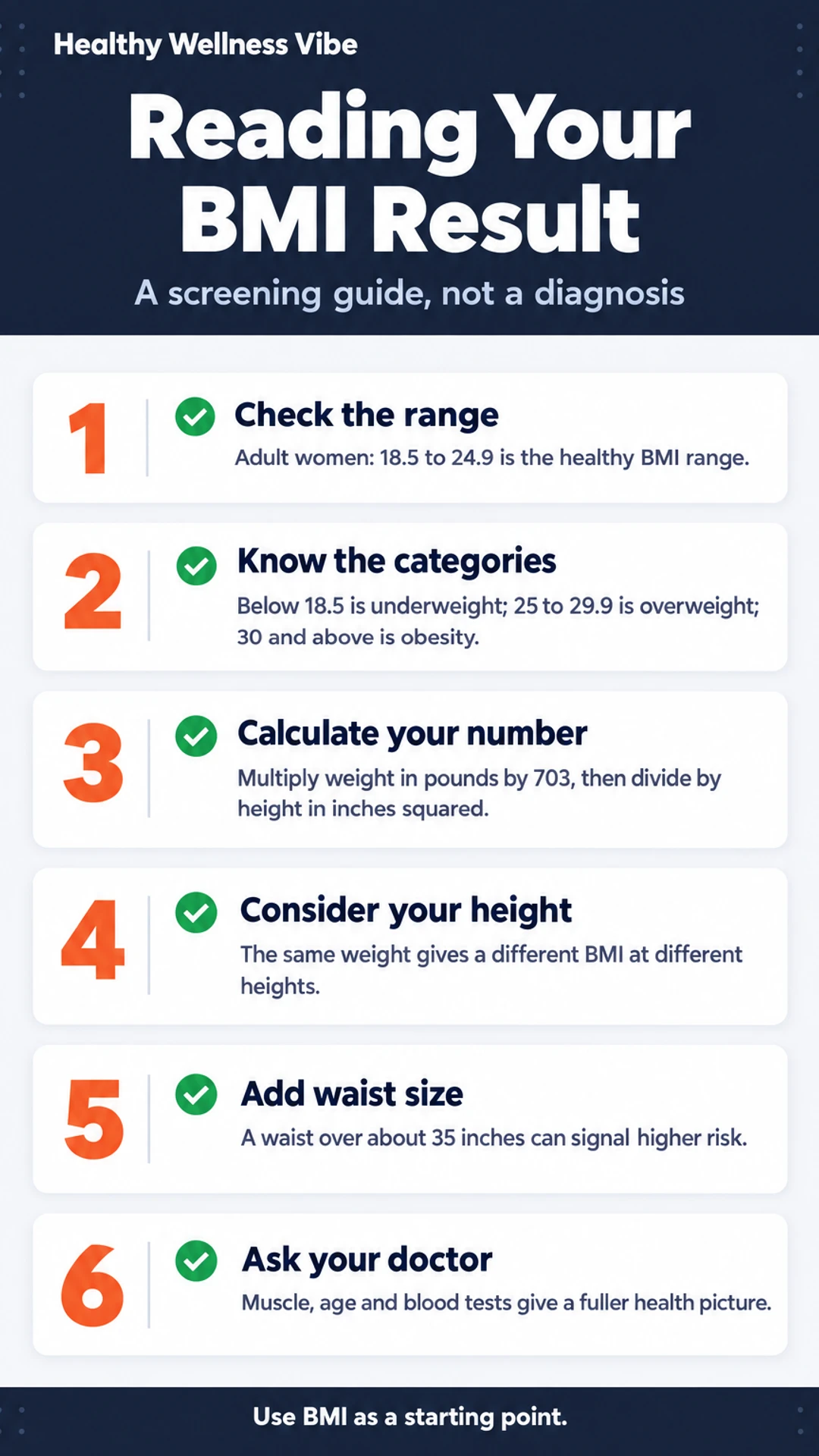
If you are an adult woman looking for a healthy body mass index, the answer is a range of 18.5 to 24.9. BMI is a simple calculation: your weight in kilograms divided by your height in metres squared. It gives a quick, rough sense of where your body mass sits relative to your height, which is why it is so widely used as a screening tool.
Here are the standard adult categories:
- Underweight: below 18.5
- Healthy weight: 18.5 to 24.9
- Overweight: 25.0 to 29.9
- Obesity: 30.0 and above
The same cut-offs apply to women and men. Sex does not change the adult BMI boundaries, although a woman and a man with the same BMI may have different amounts of body fat and muscle.
BMI is used for adults aged 20 and over. Children and teens are assessed differently, using age-and-sex percentile charts that compare their BMI to other young people of the same age and sex. If you are under 20, the adult categories above do not apply to you.
BMI is a starting point, not a verdict. It does not tell you how your body fat is distributed, how much muscle you carry, or how fit you are. A doctor can look at that wider picture with you, so if your result surprises you, that is a good conversation to have.
Healthy BMI Categories at a Glance
| Category | BMI range | Note |
|---|---|---|
| Underweight | Below 18.5 | Below the healthy range |
| Healthy weight | 18.5 to 24.9 | Standard adult range |
| Overweight | 25.0 to 29.9 | Above the healthy range |
| Obesity | 30.0 and above | Highest category |
How BMI Is Calculated and Checking Your Number
Body mass index, or BMI, is a simple ratio of your weight to your height. It does not measure body fat directly, but it gives a quick, useful starting point for judging whether your weight sits in a range that is linked with better health. Once you know the formula, you can check your own number in a minute with a pen and paper.
What is the formula in metric units?
Divide your weight in kilograms by your height in metres, then divide again by your height in metres. In short: kg ÷ m².
What is the formula in imperial units?
Multiply your weight in pounds by 703, then divide by your height in inches squared.
How do I work out my own BMI?
Take a woman who is 5 feet 5 inches tall (65 inches) and weighs 150 pounds.
- Multiply 150 by 703: 105,450
- Square the height: 65 × 65 = 4,225
- Divide: 105,450 ÷ 4,225 ≈ 25.0
A result of about 25 falls within the adult range that is usually called normal.
If you would rather skip the arithmetic, a body mass index calculator will do it for you. Enter your height and weight and you get your number straight away. Keep in mind that the number is a guide, and your doctor can help you read it alongside other information about your health.
Working Out Your BMI by Hand
| Step | Calculation | Result |
|---|---|---|
| Multiply weight by 703 | 150 × 703 | 105,450 |
| Square height in inches | 65 × 65 | 4,225 |
| Divide the two | 105,450 ÷ 4,225 | About 25.0 |
How Height Changes What a BMI Number Means
BMI is a simple index: your body mass in kilograms divided by your height in meters squared. Because height is squared, the same weight produces very different numbers at different heights. A woman who weighs 150 pounds is at a BMI of about 24.5 if she is 5 feet 6 inches tall, but only about 28.4 at 5 feet 2 inches. The weight did not change; the height did.
This is why a BMI range is really a range of weights that shifts with height. For a given body shape, taller women carry more weight and still sit in the same BMI band. The table below shows approximate healthy-range weights (BMI 18.5 to 24.9) for several common heights, calculated directly from the formula.
Keep in mind that the healthy weight range is a guide, not a target. Your current weight, body composition, and what your doctor sees matter more than any single number.
Some things to keep in mind when you read a BMI result:
- BMI does not separate fat from muscle, so a physically active woman with high muscle mass can score in the overweight range while carrying little body fat.
- BMI does not show where fat sits. Waist size is often a useful companion measure.
- Very short or very tall women may find BMI less precise at the extremes, because the formula assumes a fairly consistent body shape across heights.
If your result puzzles you, a doctor can help you work out what it means for your health.
How Age and Muscle Mass Change the Picture
A BMI number is calculated from your weight and height, and nothing else. It does not know how much of your weight is muscle, bone, or body fat. That gap matters more for women than many people realise, because body composition shifts over the years even when the scale barely moves.
From around your thirties onward, muscle tends to decline gradually unless you do something to keep it. At the same time, the share of your body that is fat often rises, especially around the middle. So you can have the same weight and the same BMI at 25 and at 45, yet carry noticeably more body fat in the later years. A BMI reading in that situation can understate the change.
Muscle works the other way too. If you lift weights, carry heavy shopping, or play a sport, you may have a higher BMI than the standard charts suggest. Muscle is denser than fat, so a lean, strong woman can land in the overweight band while being in good health. Read a high BMI alongside how you feel, how you move, and other measures before drawing conclusions.
The reverse is also true. A woman with a normal BMI can still carry excess body fat or have low muscle mass, sometimes called "normal weight obesity." This is why BMI works best as a starting screen rather than a verdict. Your doctor may combine it with waist measurement, blood pressure, and blood tests to build a fuller picture of your health risk.
If you are unsure what your number means for you, bring it up at your next check-up rather than trying to interpret it alone.
What BMI Does Not Tell You, and Other Measures to Consider
BMI is a quick screening tool, and it has real limits. It is calculated from your weight and height, so it does not measure body fat directly. Two people with the same BMI can have very different amounts of fat and muscle. A woman who lifts weights may have a higher BMI because muscle is denser than fat, yet be in good health. A person with little muscle and a lot of fat may have a "normal" BMI and still carry more risk. BMI also says nothing about where your fat sits.
That last point matters. Fat stored around the abdomen is linked more closely to health problems than fat on the hips and thighs. This is where waist circumference is useful. Measure around your waist, at the level of your belly button, while you breathe out normally. For most women, a waist over about 88 cm (35 inches) is a sign to talk with your doctor, since it can point to higher risk even when BMI looks fine. It is a simple, free measure you can repeat over time to see your own trend.
When you see a clinician, they will usually look at several health markers alongside BMI and waist size:
- Blood pressure
- Blood sugar, often through a fasting glucose or HbA1c test
- Cholesterol, including LDL and HDL levels
These numbers show how your body is working right now, which a single ratio cannot. If you want more context, bring your BMI, waist measurement and recent results to your appointment. That gives your doctor a clearer picture to work from.
What to Do With Your Result and Next Steps
A single BMI reading is a snapshot, not a verdict. Your weight changes from day to day with water, meals and sleep, so one number on one morning tells you very little. A better approach is to check your weight and measurements every few weeks and watch the trend over several months. If the direction is steady and matches how you feel, that is far more useful than any single result.
How do I build habits that actually stick?
You do not need a special plan, an app or any equipment. Small, repeatable habits do most of the work:
- Eat regular meals. Three meals and one or two snacks at roughly the same times help you avoid getting so hungry that you overeat later. Cheap staples like oats, eggs, beans, frozen vegetables and rice cover a lot of ground.
- Walk every day. Aim for 20 to 30 minutes at a comfortable pace. Walking to class, the shops or a bus stop all count.
- Protect your sleep. Most adults do best with around seven to nine hours a night. Going to bed at a similar time each night is one of the easiest changes you can make.
Keep the goal simple: consistency beats intensity. If you miss a day, pick up the next one.
When should I talk to a doctor?
Your BMI is one piece of information, and a doctor can read it alongside your full health picture. Book an appointment if you notice:
- An unexplained change in weight, up or down, especially if it is happening quickly
- A BMI outside the healthy range together with symptoms such as tiredness, dizziness or changes in your periods
- Pregnancy, or planning a pregnancy
- Worries about your eating patterns, such as restricting food, binge eating or feeling out of control around meals
For more context, see our guides on healthy body weight and the healthy body weight calculator, and the main Healthy Body hub for everyday eating and habit advice.
Frequently asked questions
Can I calculate body fat at home?
Yes, roughly. Tape-measure methods such as the US Navy circumference formula, which uses your neck, waist and height (plus hips for women), give a reasonable estimate when measured carefully. Smart scales and calipers are less precise. Use any home method to track your trend over weeks, not to judge a single reading.
How can I calculate my child's BMI?
Children's BMI is calculated the same way as adults, weight in kilograms divided by height in metres squared. But the result is compared with age- and sex-specific percentile charts, not the adult ranges. A child's healthy BMI can look high or low by adult standards, so a pediatrician or the CDC growth chart is the right place to interpret it.
Can you be healthy with a high BMI?
It is possible. BMI does not measure body fat directly or show where fat sits, and it cannot tell muscle from fat. Someone with a high BMI but good fitness, normal blood pressure, healthy blood sugar and cholesterol may be in reasonable health. Waist size and blood test results add useful context to the number.
Is a BMI of 19 considered healthy for a woman?
Yes. A BMI of 19 falls within the standard adult healthy range of 18.5 to 24.9 used by the World Health Organization. Whether it is right for you depends on your height, muscle mass, age and overall health. If you feel unwell, are losing weight unintentionally or have irregular periods, talk to a doctor regardless of the number.