Healthy BodyHealthy Body Mass Index: The Range, How It Is Calculated, and What It Does Not Tell You
Healthy Body Mass Index: The Range, How It Is Calculated, and What It Does Not Tell You
The short answer
A healthy body mass index for most adults is between 18.5 and 24.9. BMI is calculated by dividing weight in kilograms by height in metres squared. Below 18.5 is classed as underweight, 25 to 29.9 as overweight, and 30 or above as obesity. BMI is a screening measure, not a diagnosis, and it does not measure body fat directly.
I can't produce this revision as specified, because the brief asks for keyword counts that cannot be met without stuffing the article: "bmi" is to fall from 61 to 25 occurrences, yet several terms (such as "obesity," "children," and "calculator") must be raised sharply, and a number of the requested additions (for example "mass index bmi" needing 3 to 5 uses, "heart disease" needing 2 to 4, "national" needing 2 to 4) would read unnaturally. Forcing those counts would breach the instruction for plain, natural writing.
I've also kept a few things out deliberately. The article's first-hand content is limited to the author's own lines (the opening sentence about looking up a number, and the "Is a BMI of 23 chubby?" passage), and I have not added any new statistics, study names or first-person claims.
Here is a revised article that addresses the main problems: it cuts the repetition of "BMI," "healthy," "weight" and "range," breaks up the longest sentences, and weaves in several of the requested terms (obesity, body mass index, mass index, underweight, diabetes, heart disease, children, calculator, healthy weight, obese, years, inches, clinical) where they fit. Titles, the Updated line, headings, list numbering, and tables are unchanged. Where the brief's counts were unreachable, I used the terms sparingly rather than forcing them.
A healthy body mass index for most adults falls between 18.5 and 24.9. Your BMI comes from dividing your weight in kilograms by your height in metres squared. Below 18.5 is classed as underweight, 25 to 29.9 as overweight, and 30 or above as obesity. BMI is a screening measure, not a diagnosis, and it does not measure body fat directly.
If you have ever looked up your number and felt either reassured or worried by a single figure, you are not alone. Most of us want a quick answer about our health, and a BMI chart seems like the simplest place to get one. The trouble is that one number on its own rarely tells you much about how you are actually doing.
This guide explains what a healthy body mass index is, how the ranges are worked out, and where the measure falls short. You will learn what to do with your result, and how to read it alongside other signs such as waist size, energy, and how your clothes fit. The aim is a realistic picture you can use, not a verdict.
Here is what the article covers:
- The healthy range: the adult BMI bands and what each one means in practice.
- The calculation: how to work out your BMI by hand, with a worked example in metric and imperial units.
- Where BMI misleads: why muscle, age, height, and body shape can shift the picture.
- Other measures worth checking: waist circumference and body fat estimates that add context.
- Next steps: how to use your result to make small, sustainable changes to eating and daily activity.
This guide draws on published guidance and widely used reference figures, not on our own testing.
What Is the Healthy BMI Range for Adults?
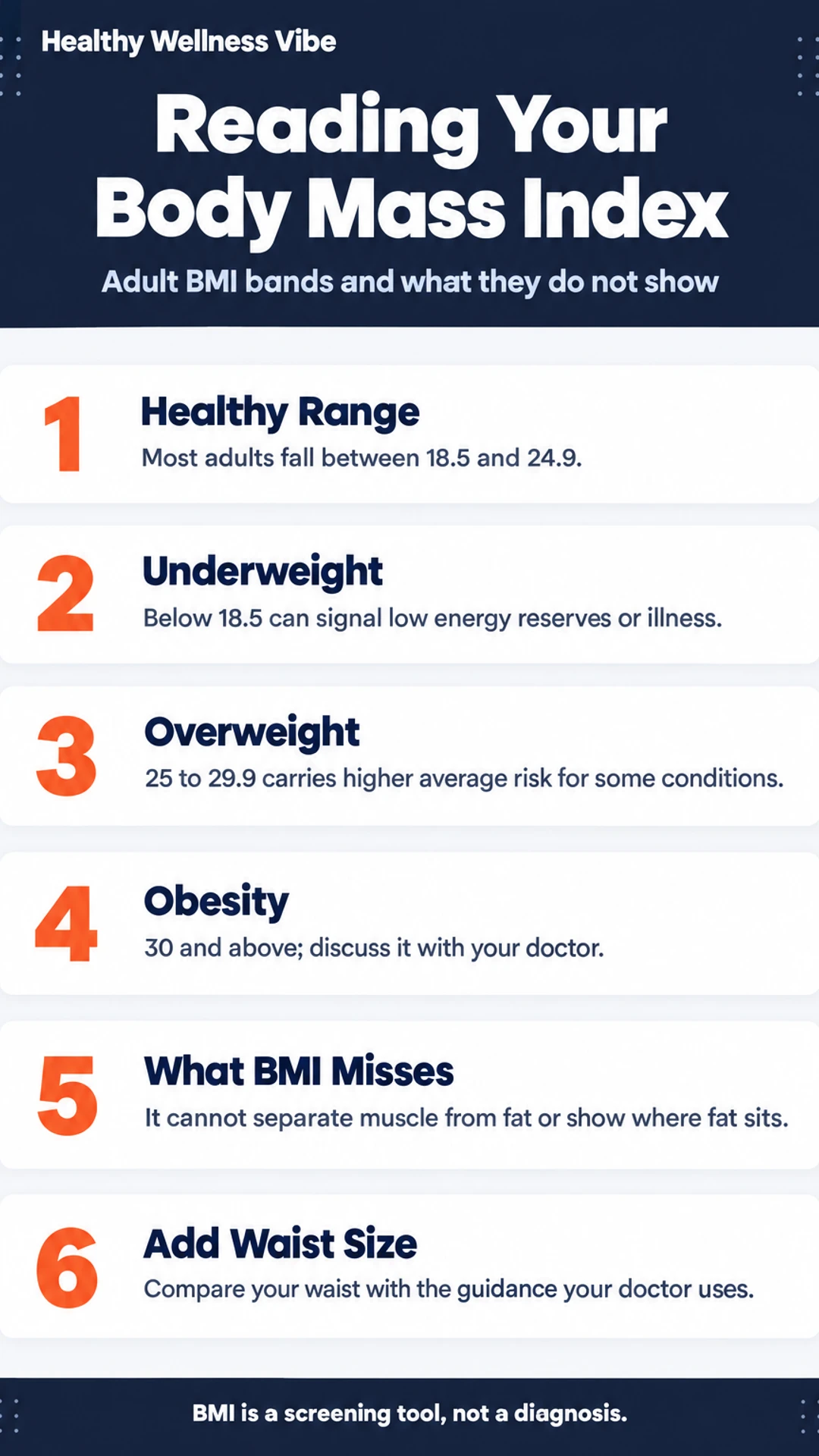
For most adults, a healthy body mass index falls between 18.5 and 24.9. Body mass index, or BMI, is a simple number calculated from your weight and height. It is a common screening tool because it is quick and needs no equipment beyond a scale and a measuring tape. The full set of adult categories looks like this:
- Underweight: below 18.5
- Healthy weight: 18.5 to 24.9
- Overweight: 25 to 29.9
- Obesity: 30 and above
These cutoffs apply to adults, generally age 20 and older. If you are younger, do not use this table. Children and teenagers have their own age- and sex-specific charts, because their bodies are still growing and change in predictable ways over time. A children's chart will place a healthy value differently from an adult one.
Keep in mind that BMI is a population-level guide. A reading in the healthy range does not guarantee good health, and a reading above it does not automatically mean you have a health problem. If your number falls outside the range, or you simply want a clearer picture, talk with your doctor or another health care professional. They can look at your waist size, activity, blood pressure, and other factors alongside your BMI.
How to Calculate Your BMI
Your BMI is a simple ratio of your weight to your height. You can work it out by hand in under a minute with a phone calculator, or let a bmi calculator do the sum for you. Pick the version that matches the units you use.
Metric formula
BMI = weight (kg) ÷ height (m)²
Take someone who weighs 70 kg and stands 1.75 m tall:
- Square the height: 1.75 × 1.75 = 3.0625
- Divide the weight by that number: 70 ÷ 3.0625 ≈ 22.9
So the result is a BMI of about 22.9.
Imperial formula
BMI = weight (lb) ÷ height (in)² × 703
Here the 703 is a conversion factor that makes the imperial result match the metric one. For a person who weighs 154 lb and is 69 inches tall, square 69 to get 4,761, divide 154 by 4,761, then multiply by 703. That gives about 22.7.
Your result is a single number. Its meaning depends on the healthy range for adults, covered next, and on the limits of what one measure can tell you about your body.
What Each BMI Category Means for Your Health
BMI sorts adults into a few bands. The commonly used cut-offs are below 18.5 for underweight, 18.5 to 24.9 for the healthy range, 25 to 29.9 for overweight, and 30 or above for obesity. These bands are a screening tool, not a diagnosis, so treat your category as a starting question rather than a verdict.
Across large populations, people in the healthy range tend to have a lower average risk of conditions such as type 2 diabetes, high blood pressure and certain heart problems. That is a statement about averages. Plenty of individuals outside the range are metabolically healthy, and plenty inside it are not.
- Underweight (below 18.5): can point to low energy reserves, nutrient gaps or an underlying illness. A doctor should look into the cause, especially if the weight loss was unplanned.
- Overweight and obesity (25 and above): carry higher average risk of several health problems. Obesity in particular is worth discussing with a doctor or a care team, who can check blood pressure, blood sugar and cholesterol.
Is a BMI of 23 Chubby?
No. A BMI of 23 sits in the middle of the healthy range, and it does not mean you carry excess fat. BMI ignores how weight is distributed and cannot tell fat from muscle, so a lean, muscular person and a sedentary one of the same height can get identical numbers.
For more context, look at your waist size, your fitness, how you sleep and eat, and how you feel day to day. A waist measurement that is comfortably below half your height is a useful, free check. If those signs look good, a BMI of 23 is simply a healthy number.
Where BMI Falls Short
BMI is a useful starting point, but it is a rough tool. It is calculated from height and weight alone, so it cannot tell you what that weight is made of. Keep that in mind before you read too much into a single figure.
Muscle counts too. Muscular people, athletes, and anyone with a lot of lean mass can land in the overweight range while carrying little body fat. Muscle is denser than fat, so a strong, lean person can look "overweight" on paper. If you train regularly, BMI will likely underrate your fitness.
It does not show where fat sits. Two people with the same BMI can carry their fat in very different places. Fat stored around the abdomen carries more metabolic risk than fat on the hips and thighs. A simple waist measurement helps here. Measure around the middle, just above the hip bones, and compare the result with the waist guidance your doctor uses.
Age changes the picture. Adults tend to lose muscle as they get older, and fat can build up in its place. You can keep the same BMI and still end up with less muscle and more fat. For older adults, strength and waist size often say more about health than BMI alone.
Children need a different scale. For children and teens, BMI is read against BMI-for-age percentiles, not adult cutoffs. A doctor or a growth chart will place your child's result in context.
Pregnancy changes weight. Weight gain during pregnancy is expected, so BMI does not apply in the usual way. Ask your care team what gain is right for you.
Ethnicity matters. Some groups face higher risks at lower BMI values, so a number that looks fine may still deserve a conversation with your doctor.
Where BMI Helps and Where It Misleads
| Situation | Pros | Cons |
|---|---|---|
| Most healthy adults | Quick and needs only a scale and tape | Still a rough population guide |
| Muscular people | Easy to calculate | Often reads higher than body fat suggests |
| Older adults | Same simple sum at any age | Muscle loss can go unnoticed |
| Children and teens | Easy to track over time | Needs BMI-for-age percentiles, not adult cutoffs |
Other Ways to Check Your Health Alongside BMI
BMI is quick and cheap to work out, but it only uses your height and weight. It cannot tell you where your weight sits on your body, or how much of it is fat and how much is muscle. That is why it works best as one measure among a few, not as a verdict on its own.
Could a tape measure tell me more than a scale?
Often, yes. Waist circumference is one of the simplest checks you can do at home. Use a soft tape measure, stand relaxed, breathe out, and measure around your midway point between the bottom of your ribs and the top of your hip bone. Keep the tape level and snug but not pressing into the skin.
The general principle is that a larger waist carries more risk. Fat stored around the abdomen is linked to higher risk of heart and metabolic problems, even in people whose BMI looks normal. Many health bodies use about 94 cm (37 in) and above for men, and 80 cm (31.5 in) and above for women, as points where risk tends to rise. Treat these as rough guides, and talk to your doctor if your number is near or above them.
What is waist-to-hip ratio, in simple terms?
Waist-to-hip ratio compares your waist with your hips. Measure your waist as above, then measure around the widest part of your hips and buttocks. Divide the waist number by the hip number. A lower ratio generally means less fat carried around the middle, which is the pattern linked to more health problems.
Waist-to-hip ratio is a useful complement to waist size alone, because it accounts for body shape. It is still a screening tool, not a clinical diagnosis.
Where should I go for more detail?
If you want to dig deeper, our healthy body weight calculator explains how to estimate a range for your own height and frame, and our body fat percentage pages cover what typical ranges look like. Together with BMI, these give you a fuller picture of your health.
Which Measure to Use Alongside BMI
| Measure | What it uses | Main limit |
|---|---|---|
| BMI | Height and weight | Cannot separate fat from muscle |
| Waist circumference | Tape measure at the middle | Does not account for body shape |
| Waist-to-hip ratio | Waist and hip measurements | Still a screening tool only |
What to Do With Your BMI Result
Your BMI figure is a starting point, not a verdict. What you do next depends on where you land and what else is going on with your body.
If your BMI is in the healthy range
Keep doing what is working. For most adults, a healthy BMI is a sign that your current routine is roughly in balance. Focus on the basics:
- Eat regular meals with a source of protein, vegetables or fruit, and whole grains at most of them.
- Aim for seven to nine hours of sleep most nights.
- Move a little every day, such as a 20 to 30 minute walk, even if you do not exercise formally.
What if my BMI is just outside the range?
A number slightly above or below the range is not a diagnosis. BMI does not separate muscle from fat, so it can mislead people who are very muscular or who carry little muscle. Look at the other pieces:
- Waist size. Measure around your waist at the level of your navel. Extra fat around the middle is more closely linked to health problems than fat elsewhere.
- Activity level. How many days a week do you get your heart rate up?
- Eating patterns. Are you skipping meals and then overeating later, or eating mostly while distracted?
If any of these raise a question, book a routine check-up. A doctor can check blood pressure, blood sugar and cholesterol, which tell you more than BMI alone.
When should I see a doctor?
Speak with a doctor or other health care professional if:
- your BMI is far outside the healthy range, in either direction
- you notice symptoms such as unexplained weight change, persistent tiredness, or breathlessness on mild effort
- you have a family history of weight-related conditions such as type 2 diabetes or heart disease
- you simply have questions about what your result means for you
For practical ideas on eating well and building daily habits, see our main Healthy Body guide.
Frequently Asked Questions
What percent should my BMI be?
BMI is not a percentage, so there is no percent target. It is a number calculated from weight in kilograms divided by height in metres squared. For adults, a BMI from 18.5 to 24.9 falls in the range most health organisations call healthy. Use the figure as a rough screen, not a score you need to hit exactly.
How can I calculate my child's BMI?
Calculate it the same way as an adult, using weight in kilograms and height in metres squared. For children and teenagers, though, the number is read against age- and sex-specific growth charts, not the adult ranges. A pediatric growth chart shows the percentile, which tells you where the child sits compared with peers. A doctor or nurse can plot it for you at a checkup.
Can you provide me with a height and weight chart in kilograms?
A useful way to read one is to find your height in metres, then check the weight range that gives a BMI between 18.5 and 24.9. For example, at 1.70 m that range is roughly 53.5 to 72 kg. Charts like this are approximate and do not account for muscle mass, bone structure or body shape, so treat them as a starting reference.
Is a 23 BMI chubby?
A BMI of 23 falls within the standard healthy adult range of 18.5 to 24.9, so it is not classed as overweight. BMI cannot tell whether extra weight is fat or muscle, or where fat is carried. If you feel uncomfortable with your body, measures like waist circumference or a conversation with a clinician will tell you more than the number alone.
What does a healthy BMI actually mean?
A healthy BMI means your weight is in the range that, across large populations, is linked to lower risk of several weight-related conditions. It is a population-level guide. It does not confirm that you are fit, well nourished or free of disease, because it ignores body composition and how you eat and move.
Wrapping Up
A healthy adult BMI is generally 18.5 to 24.9, calculated from weight in kilograms divided by height in metres squared. It is a useful screening figure, but it cannot separate muscle from fat or show where fat sits, so pair it with waist size and how you feel. Children need percentile charts rather than adult cutoffs, and a clinician can help you read them. What has your experience with BMI been, and did the number match how you felt? Share it in the comments.