Healthy BodyHealthy Body Fat Percentage for Women: Typical Ranges and What They Mean
Healthy Body Fat Percentage for Women: Typical Ranges and What They Mean
The short answer
For most adult women, a healthy body fat percentage falls roughly between 21 and 35 percent, though published charts vary. Athletes often sit between 14 and 20 percent, and women carry more essential fat than men, about 10 to 13 percent compared with 2 to 5 percent. Age, activity and how you measure all shift the number, so a single reading is best read as a range.
If you have searched for a healthy body fat percentage for women, you have probably found several charts that disagree with each other. One lists a range that looks too high, another puts you in the "athletic" category without explaining why, and none of them tell you what to do with the number once you have it. That confusion is frustrating, especially when you just want a fair picture of your own health.
This guide gives you a clearer starting point. You will see the typical ranges for women and how they differ from the ranges used for men, why essential fat matters, and how age and daily activity shift what is normal for you. We will also look at the common ways body fat is measured, including scales, tape measures and calipers, and where each one tends to mislead.
This guide is based on published specifications and what buyers report, not our own testing.
Here is what the article covers:
- Typical ranges for women by age group and activity level
- Why women need more essential fat than men, and what that means for the numbers
- How measurement methods differ and how far a reading can drift
- What your range can and cannot tell you about your health on its own
- Practical habits that support a healthy body composition without special equipment
Your Realistic Daily Capacity Planner
What a Healthy Body Fat Percentage Looks Like for Women
The commonly published range for women is about 21 to 35 percent body fat. Different charts and organizations draw the lines a few points apart, so you may see slightly different numbers depending on the source. Treat the range as a general reference rather than a precise cutoff.
Body fat percentage describes how much of your total body weight is fat mass, as opposed to lean mass such as muscle, bone, and water. Women carry a higher share of essential fat than men do, partly for reproductive function, so the healthy range for women sits higher than the one used for men.
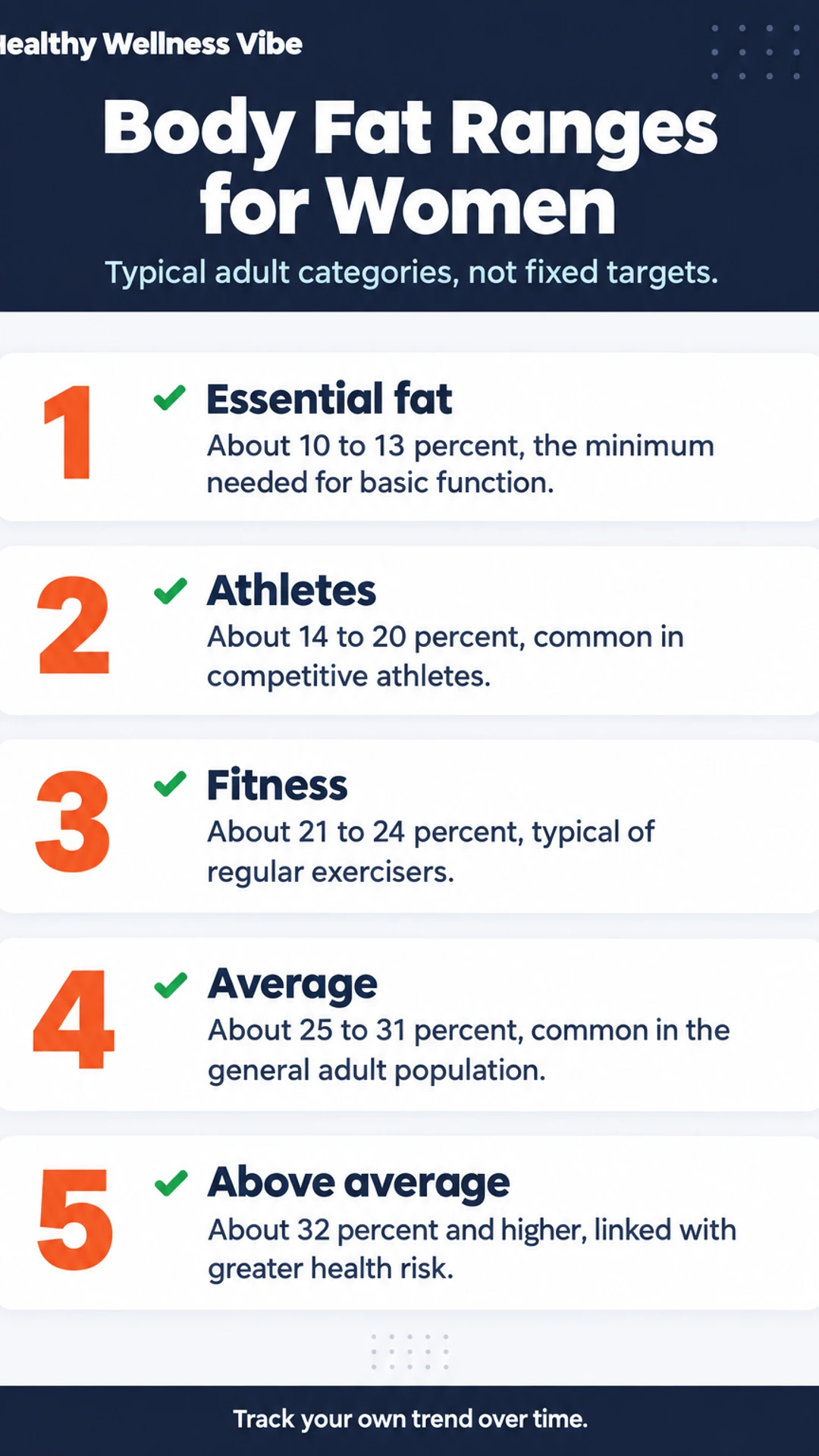
The categories most charts use look roughly like this:
- Essential fat: about 10 to 13 percent. This is the minimum needed for basic body function, and levels below it are not sustainable long term.
- Athletes: about 14 to 20 percent. Common among competitive athletes who train hard year-round.
- Fitness: about 21 to 24 percent. Typical of people who exercise regularly.
- Average: about 25 to 31 percent. Common in the general adult population.
- Obese or overfat: 32 percent and above. Higher levels are linked with greater health risk.
Is a range a target I should hit?
No. A range is a reference point, not a goal to chase. Your body composition depends on your genetics, age, activity, and life stage, and a number that suits one woman may not suit another. Focus on steady habits, such as regular movement and eating enough protein and vegetables, and let your body settle where it naturally does.
Women's and Men's Body Fat Ranges Compared
Women typically carry a higher body fat percentage than men, and that difference is built into normal physiology. Some of it is essential fat, the minimum fat your body needs to function. In women this includes fat in the breasts, the pelvis, and the reproductive organs, and it supports hormone production, including the estrogen that drives the menstrual cycle. Men have less essential fat, mainly in the bone marrow, the nervous system, and the organs. Because women need more of this baseline fat, a healthy range for women starts higher.
Muscle mass also plays a role. On average, men carry more lean muscle, which means a smaller share of their total weight is fat. That is why the same body weight can produce different body fat numbers for a man and a woman.
Here is how the typical categories compare for adults:
- Essential fat: about 10 to 13 percent for women, about 2 to 5 percent for men
- Athletes: about 14 to 20 percent for women, about 6 to 13 percent for men
- Fitness: about 21 to 24 percent for women, about 14 to 17 percent for men
- Average: about 25 to 31 percent for women, about 18 to 24 percent for men
- Above average: about 32 percent and higher for women, about 25 percent and higher for men
These are general categories, not targets. The sex difference reflects body composition, not a judgment about women or men. Neither group is healthier by default. A single number tells you little on its own, so think of it as one piece of a bigger picture that includes how you feel, how active you are, and how your body responds to everyday habits.
Typical body fat categories for women and men
| Category | Women | Men |
|---|---|---|
| Essential fat | About 10 to 13 percent | About 2 to 5 percent |
| Athletes | About 14 to 20 percent | About 6 to 13 percent |
| Fitness | About 21 to 24 percent | About 14 to 17 percent |
| Average | About 25 to 31 percent | About 18 to 24 percent |
| Above average | About 32 percent and higher | About 25 percent and higher |
How Your Range Changes With Age and Activity
A healthy body fat percentage for women is not a single fixed number. It shifts across life, and it depends on how active you are. Knowing that helps you read your own results more sensibly.
Body fat tends to rise slowly as women get older. Muscle mass often declines with age if you are not doing resistance work, so the same body weight can carry a higher fat percentage at 50 than at 25. Around and after menopause, many women notice that fat storage moves toward the midsection. That change in distribution matters for health risk, so it is worth paying attention to waist size alongside your overall percentage.
Activity changes the picture for women who train regularly. Strength work builds muscle, and cardio helps manage fat, so an active woman usually sits lower on the scale than a sedentary woman of the same age. That means a percentage that looks high for a typical adult may still fall in a healthy range for someone who lifts or runs several times a week. Put simply, consistent training moves your personal range in a favorable direction.
- Lower body fat often comes with more muscle, not just less fat.
- Age-related changes are gradual, so year-to-year trends tell you more than a single reading.
- Changes in waist size can be as informative as the overall percentage.
Avoid comparing yourself with someone of a different age or training history. A 22-year-old competitive runner and a 58-year-old who just started walking will have very different but equally reasonable numbers. Compare yourself with your own past readings instead.
How to Measure Body Fat and Read Your Result
Body fat percentage is the share of your total weight that comes from fat tissue, as opposed to muscle, bone, water and organs. No method measures it perfectly, so the goal is a consistent estimate you can track over time, not a single exact number.
Which measuring method should I choose?
Most people will use one of five options, each with a different balance of access, cost and accuracy:
- DEXA scan: Often treated as a reference method. It is usually done at clinics or research centres, can cost a fair amount, and gives a detailed breakdown of body composition.
- Hydrostatic weighing: Measures body density by weighing you underwater. It is accurate but needs a specialised tank and trained staff, so access is limited.
- Bod Pod: Uses air displacement in a sealed chamber. It is fairly accurate and quick, but still found mainly in labs and some fitness centres.
- Bioelectrical impedance (BIA) scales: Send a weak current through your feet. They are cheap and easy, but results shift with hydration, so they are best for trends.
- Skinfold calipers: Pinch-test fat at several sites. Inexpensive, but accuracy depends heavily on who takes the measurements and how.
If you have no special equipment, a BIA scale or a caliper measurement taken by the same person each time will serve your purposes well.
Why does my reading change from day to day?
Home scales can swing by several percentage points in a single day. Hydration, a recent meal, exercise, salt intake and time since you last used the toilet all affect the electrical signal and therefore the result. A reading taken after a workout will look different from one taken first thing in the morning.
How do I compare results fairly?
- Measure at the same time of day, ideally on waking and before eating.
- Use the same method and, where possible, the same device.
- Avoid heavy exercise or a big drink of water right before testing.
- Look at the average over several weeks rather than any single reading.
A downward or upward trend across a month tells you far more than one number on one morning.
Common body fat measurement methods
| Method | Access |
|---|---|
| DEXA scan | Clinics or research centres |
| Hydrostatic weighing | Specialised tank and trained staff |
| Bod Pod | Labs and some fitness centres |
| BIA scales | Home use, easy access |
| Skinfold calipers | Home or fitness centre |
What Very Low and Very High Body Fat Can Mean
Body fat is not something to minimize at all costs. Women need a meaningful amount of essential fat for normal hormone production, and the body treats it as a signal of how much energy is available. When body fat drops well below the typical range for women, the body can respond by slowing functions that are not needed for immediate survival.
The most common concerns at the low end include:
- Irregular or missed menstrual periods
- Persistent fatigue and feeling cold more often
- Lower energy for training and daily tasks
- Changes in mood, sleep, and recovery after exercise
At the high end, the concern is less about the number alone and more about metabolic risk. Excess fat carried around the abdomen is linked to higher blood pressure, unfavorable blood sugar and cholesterol readings, and greater long-term cardiovascular risk. This is why waist size and fitness matter alongside the percentage. Two people with the same body fat percentage can carry different risk depending on where that fat sits and how active they are. A waist measurement and a regular activity habit tell you more than a single figure does.
Some signs call for a conversation with a doctor rather than a self-adjustment, such as:
- Periods that stop or become very irregular for several months
- Unexplained weight loss, or weight gain you cannot account for
- Dizziness, fainting, or unusual breathlessness
- Persistent fatigue that does not improve with rest
- Blood pressure, blood sugar, or cholesterol readings that concern you
Body Fat Percentage, BMI, and Common Questions
BMI is a quick screen based only on height and weight. It cannot tell whether a body's weight comes from fat or from muscle, which is why two women of the same height and weight can have very different body composition. Body fat percentage looks at the share of your total mass that is fat, so it can tell a different story. A woman who lifts weights regularly may carry more muscle mass and a lower fat percentage than her BMI alone would suggest.
What is essential fat, and why does it matter?
Essential fat is the minimum fat your body needs to function. It is stored in the bone marrow, nervous system, and cell membranes, and it supports hormone production and temperature regulation. For women, essential fat is higher than for men because it also supports reproductive health. Typical essential fat for women is around 10 to 13 percent, and a fat percentage far below that can be a health risk.
For comparison, healthy ranges for men are generally lower, roughly 8 to 19 percent for most adult men. The gap reflects these sex-specific needs, not a judgment about either group.
Habits that support healthy body composition
Body composition changes slowly, and the habits below help more than any single food or workout:
- Eat protein at most meals. Eggs, beans, lentils, tofu, yogurt, fish, or chicken help you keep and build muscle.
- Fill half your plate with vegetables. Frozen vegetables are affordable and just as useful as fresh.
- Move every day. A 20 to 30 minute walk counts, and two or three short strength sessions a week build muscle with no equipment beyond your body or a few bottles of water.
- Aim for regular sleep. Most adults do best with 7 to 9 hours, and poor sleep makes hunger and cravings harder to manage.
Start with one or two of these, not all of them. Small, repeatable habits are more realistic on a busy schedule than a strict plan you will abandon in a week.
Frequently asked questions
What is essential fat?
Essential fat is the minimum amount of body fat needed for normal physiological function. It is found in the bone marrow, nervous system, cell membranes, and organs, and it supports hormone production and temperature regulation. For women it is typically higher than for men because it includes fat needed for reproductive function and breast tissue.
How much body fat should a 60 year old man have?
For most men aged 60, a body fat percentage in the range of roughly 18 to 24 percent is commonly considered healthy, though acceptable values vary by measurement method and individual health. Body fat tends to rise with age even when weight stays the same, so a reading that looks similar to a younger man's can carry different implications. A doctor can help interpret your own number.
Is body fat percentage the same as BMI?
No. BMI is a ratio of weight to height and does not distinguish fat from muscle or bone. Body fat percentage measures how much of your total weight is fat. Two people with the same BMI can have very different body fat levels, which is why body fat percentage can give a more detailed picture, though it is harder to measure accurately at home.
What is the healthy body fat percentage for men?
For adult men, a commonly cited healthy range is about 10 to 20 percent, with athletes often lower and older adults often somewhat higher. Men typically carry less essential fat than women, so their ranges sit lower. Measurement methods differ in accuracy, so compare readings only when taken the same way and interpret them alongside your overall health.
What is a healthy body fat percentage for women?
For adult women, a commonly cited healthy range is about 21 to 33 percent, with athletes often closer to 14 to 20 percent. Women carry more essential fat than men, partly for reproductive health, so their typical ranges run higher. Readings from home scales or calipers vary, so treat any single number as a rough guide.
Wrapping up
A healthy body fat percentage for women typically falls around 21 to 33 percent for adults, and it is higher than the range for men because women need more essential fat. Treat any single reading as a rough guide and look at it alongside your energy, sleep, and overall health. Have you measured your body fat before, and did the number match what you expected? Share your experience in the comments.